

How to Get a White Belt in Lockpicking: The 2026 Locksport Entry Guide
What if your first step toward mastery didn't require a locksmith's license or a secret background? You've likely watched a lock click open in a video and felt that spark of curiosity. It's natural to feel overwhelmed by technical terms or nervous about the laws surrounding the hobby. If you're ready to start, learning how to get a white belt in lockpicking is the perfect way to join a global community of ethical problem-solvers. We treat this as a legitimate sport where precision and patience are the only requirements for entry.
You probably want to avoid wasting money on low-quality tools or overly complex gear. We promise to show you the exact practice locks and beginner lockpick sets required to earn your first official rank. This guide provides a clear path to successfully picking your first lock and submitting a valid photo for your White Belt. We'll walk through the essential tools, the legal basics of the hobby, and how to connect with the LockPickers United community for your first big win.
Key Takeaways
- Understand the standardized roadmap used by the global locksport community to track your progression from a curious novice to a master picker.
- Learn the exact two-step submission process required to verify your first successful open with community moderators.
- Discover how to get a white belt in lockpicking by mastering technical specs on foundational targets like the 4-pin Master Lock #3.
- Identify the specific Beginner Lockpick Sets and Practice Locks that offer the best tactile feedback for trainee-level skill development.
- Explore the next steps in your journey, including how to join the Black Belt Challenge and advance toward Yellow belt status.
What is the Locksport Belt Ranking System?
The Locksport Belt Ranking System is the heart of our community. Think of it as a standardized roadmap that guides you from a total novice to a master picker. This isn't just about opening locks; it's about proving your skill through a series of increasingly technical challenges. The system is maintained by Lock Pickers United (LPU), a dedicated group of volunteers who ensure every rank represents a real achievement. If you're wondering how to get a white belt in lockpicking, you're starting at the most critical stage. This is where you develop the foundational feel for pin tumbler mechanics that will serve you throughout your entire hobbyist career. Starting here allows you to learn how pins react to your tools without the frustration of complex security features found in higher tiers.
It's vital to distinguish between the sport and the trade. What is Locksport? It's a hobby focused entirely on the puzzle-solving aspect of mechanical security. Locksmiths are professionals who provide services for hire. We are hobbyists. We treat cylinders as technical puzzles. This distinction helps us maintain a positive relationship with professionals worldwide. We don't offer services; we build skills.
From White to Black: The Journey of a Hobbyist
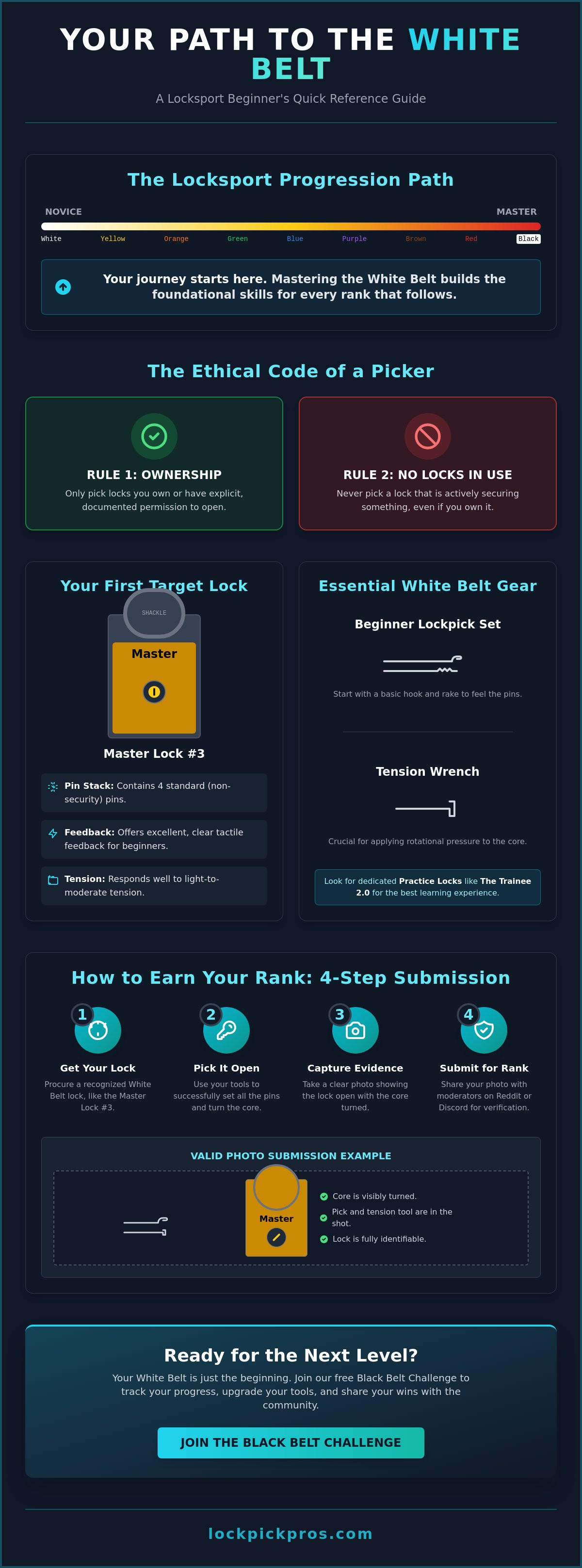
The journey begins at White and progresses through Yellow, Orange, Green, Blue, Purple, Brown, Red, and finally, Black. Each tier introduces new obstacles that test your precision. While White belts focus on standard brass pins, later levels bring in security features like spool, serrated, or mushroom pins. In 2026, the verification process remains entirely community-driven. You'll need to share a photo or video of your success with fellow enthusiasts on platforms like Reddit or Discord to earn your flair. Learning how to get a white belt in lockpicking is your passport into this rewarding progression. It's the first time you'll feel that satisfying click of a plug turning, a sensation every Black Belt remembers fondly.
The Ethical Code of the White Belt
Ethics are the backbone of our sport. We follow two non-negotiable rules to maintain community recognition and legal safety. First, never pick a lock you don't own or haven't received explicit permission to open. Second, never pick a lock that is currently in use, such as a front door or a padlock securing a gate. If you accidentally damage a lock while practicing, you could find yourself locked out or unable to secure your property. This is why Practice Locks and dedicated sets like The Trainee 2.0 are so important. They allow you to hone your craft on your own terms. Following these rules proves you're an ethical lockpicker worthy of the ranks.
The White Belt Submission Process: Step-by-Step
Earning your first rank is a defining moment for any hobbyist. It marks your official entry into the world of competitive lockpicking. While higher ranks require complex video documentation, the White Belt is designed to be accessible. It focuses on the core mechanics of the sport. If you are researching how to get a white belt in lockpicking, the process is straightforward but requires attention to detail to ensure your evidence is accepted by community moderators.
- Step 1: Procure a recognized lock. Start with something from the LPU White Belt list. Common choices include the Master Lock #3 or various simple padlocks found at hardware stores.
- Step 2: Successfully pick the lock to the 'open' position. Use your tension wrench and hook to set the pins. You'll know you've won when the plug rotates and the shackle springs free.
- Step 3: Capture the evidence. Take a clear photo of your success. The goal is to show the community you achieved the open without a key.
- Step 4: Submit for verification. Send your proof to the moderators on Reddit or Discord to claim your first rank and community flair.
Photographing Your Success
Your photo is your trophy. To make it valid, the lock's core must be visibly turned. A photo of an open padlock with the core in the locked position doesn't prove it was picked; it could have been opened with a key and then relocked. Ensure the plug is rotated at an angle. Good lighting is essential. Position your Beginner Lockpick Sets and tension tools next to the lock. This shows the community exactly what you used to achieve the open. While higher tiers require uncut video to prevent trickery, a single high-quality photo is all you need for your White Belt. If you're looking for gear that provides the feedback needed for these early wins, consider upgrading to a Carbon Fiber Gen 2 Pro Series set for superior tactile response.
Where to Submit Your Rank Request
The r/lockpicking subreddit is the most popular destination for rank requests. Once you post your photo with a title requesting your belt, a moderator will review it and grant you your first flair. You can also join the LPU Discord server for faster interaction and real-time advice. For those who want to track their long-term progress, the LPU Belt Explorer acts as a formal digital resume. Don't forget to link your social media accounts. Many hobbyists participate in share-to-earn programs that reward you for documenting your journey. Understanding how to get a white belt in lockpicking is just the start of building your reputation in this ethical community.
Your First Target: Picking the Master Lock #3
To tackle this classic target, we recommend using a standard short hook and a bottom-of-the-keyway (BOK) tension wrench. These tools are the bread and butter of any Beginner Lockpick Sets and provide the necessary reach to manipulate all four pins without over-lifting. Before you tension your first lock, always ensure you are operating within the Lock Picking Laws of your jurisdiction. Being an ethical hobbyist means staying informed and responsible as you grow your skills.
Step-by-Step Picking Instructions
Success with the Master Lock #3 comes down to tension control. Follow these steps to achieve your first open:
- Apply Tension: Insert your BOK wrench and apply 'medium' clockwise pressure. You want enough force to create a ledge for the pins to sit on, but not so much that you bind the core.
- Find the Binder: Gently move your short hook to the back of the lock. Test each pin. The 'binding' pin is the one that feels stiff or resists movement more than the others.
- Set the Pin: Lift the binding pin slowly. You should feel a slight click and a tiny nudge in the tension wrench. This means the pin has reached the shear line.
- Repeat: Continue searching for the next binding pin. Once all four are set, the core will rotate freely, and the shackle will pop.
Avoid over-setting at all costs. Pushing a pin too high is the most common beginner mistake. If the pins feel completely stuck, you've likely applied too much tension or pushed a key pin past the shear line.
Understanding the Pin Stack
To master this lock, you must visualize what's happening inside. Each of the four chambers contains a 'key pin' (the one your pick touches) and a 'driver pin' (the one pushed by the spring). Your goal is to lift the junction between these two pins to the 'shear line,' which is the gap between the plug and the lock body. The Master Lock #3 is a 'pure' experience because it contains no security pins like spools or serrated drivers. This allows you to focus entirely on the basic mechanics. If you feel like you've over-set a pin or the lock isn't responding, simply release your tension wrench to 'reset' the stack. You'll hear the pins drop back down, allowing you to start fresh with a more refined touch.
Essential Tools for the White Belt Tier
Starting your journey doesn't require a massive investment. In fact, using entry-level steel picks is often better when you're first learning how to get a white belt in lockpicking. These tools provide raw, unrefined feedback that helps you distinguish between a binding pin and a set pin. While advanced pickers love thinner profiles, a standard 0.025-inch steel pick is durable. It can withstand the heavier hand most beginners use without snapping. This durability is essential while you're still calibrating your finger-feel for the pins.
Maximizing your tactile sensitivity starts with how you hold your pick. Grip it like a pen, but keep your index finger extended along the shaft. This allows vibrations from the pins to travel directly into your fingertips. Choosing the right tension wrench is equally vital. A wrench that is too small will slip and mar the keyway. One that is too large will bind the core against the lock body, making it impossible to feel the pins. You want a snug fit that allows for precise control over the rotational force you apply.
The Trainee's Toolkit
For many, The Trainee 2.0 is the ideal starter kit for White Belt seekers. It includes foundational tools and, most importantly, a transparent training set. These clear practice padlocks are game-changers for visual learners. They allow you to see the driver and key pins move in real-time. Once you understand the visual cue of a pin reaching the shear line, you'll find it much easier to transition to blind metal locks. Moving from a clear lock to a Master Lock #1 or #3 is the standard progression for any ethical lockpicker.
Upgrading as You Progress
As your sensitivity improves, you'll naturally outgrow basic steel. This usually happens as you move toward Yellow or Orange belt ranks. This is the perfect time to move from basic sets to the Carbon Fiber Gen 2 Pro Series. Better steel quality and rigid handles improve feedback significantly, which is necessary for feeling the subtle clicks of security pins. If you're still unsure which path to take, check out our guide on How to Choose Your First Beginner Lock Pick Set for a deep dive into tool metallurgy and handle styles. Understanding how to get a white belt in lockpicking is about matching your tools to your current skill level while preparing for the challenges ahead.
Ready to start your journey with the right gear? Pick up the Carbon Fiber Gen 2 Pro Series to ensure you have the best feedback possible for your first official rank submission.
Beyond White: Joining the Black Belt Challenge
Once you've mastered the basics of how to get a white belt in lockpicking, the real adventure begins. The transition from White to Yellow belt marks a significant shift in mechanical difficulty. You're no longer just pushing standard brass pins. You're entering a world where the lock is designed to fight back. Yellow belt targets often include security features that require more refined tension and better pick placement. This is the first step in our Black Belt Challenge, a structured path designed to take you from a curious trainee to a master of the sport. We provide the roadmap; you provide the patience.
We believe in celebrating every click. That's why we've built a community bounty system to reward your progress. By sharing your "picks-in-action" on social media, you can earn exclusive gear and rewards. If your progress videos hit specific social reach goals, you'll unlock community bounties from our inventory. Just as enthusiasts in other niche markets might visit Lab X Supply to find limited-edition items, our members come here to find specialized tools. It's our way of fostering engagement and growing the ethical lockpicking community together. Every rank you earn is a testament to your growing precision and dedication.
The Share-to-Earn Loop
Don't let your White Belt success go unnoticed. Post your verified open on Instagram or TikTok using #LockpickPros to join our share-to-earn loop. Once your first pick is verified by the community, you can claim a "Next Step" discount for your next set of tools. Starting this habit early is crucial for your long-term goals. As you advance, Green Belt and higher ranks require uncut video proof of the pick and the gutting process. Building a portfolio of your opens now helps you practice the camera angles and lighting needed for those advanced tiers. It's about documenting a journey of mastery, one lock at a time.
Preparing for Yellow Belt
The logical next step after the Master Lock #3 is the Master Lock 140. This lock introduces a spool pin, which is a security feature that creates a "false set" to trick the picker. You'll need to expand your toolset to handle these tighter tolerances and thinner keyways. The Pro Series Expansion is designed exactly for this transition. It provides the specialized tensioners and hooks needed for intermediate cylinders. Join the Black Belt Challenge for free today to download your progress tracker. You've already mastered how to get a white belt in lockpicking; now it's time to see how far your skills can go. Grab your picks and let's get to work on that next rank.
Your Journey to Mastery Starts Today
You now have the exact roadmap for your first successful open. From mastering the 4-pin stack of the Master Lock #3 to capturing the perfect verification photo, the path to your first community flair is clear. We've mentored over 10,000 ethical pickers and were community-voted the #1 beginner resource for 2026. Learning how to get a white belt in lockpicking is just the beginning of a lifelong pursuit of precision and skill. We provide precision-engineered tools for every belt rank to ensure you always have the best tactile feedback possible.
The locksport community is waiting to welcome you. Your journey from a curious trainee to a master picker starts with a single click and a lot of patience. We're here to support you at every tier with the gear and guidance you need to succeed. Don't wait to feel that first satisfying turn of the core. It's time to put your tools to work and earn your place among the ranks. We can't wait to see your first submission.
Join the Free Black Belt Challenge and Start Your Journey!
Frequently Asked Questions
Is lockpicking legal for hobbyists in the US?
Owning lock picks is legal in all 50 US states as long as you don't have criminal intent. Most jurisdictions view these as simple tools. However, a few states consider possession "prima facie" evidence of intent, so always check your local regulations before carrying them in public. As an ethical lockpicker, you should only pick locks you own or have explicit permission to open.
Do I need a video to get a White Belt?
You don't need a video for a White Belt submission. A single, clear photograph showing the core in the turned position and the shackle open is enough to prove your success. Higher ranks, specifically starting at Green Belt, require uncut video to verify both the picking and the gutting process. For your first rank, keep it simple and focus on a high-quality still image.
What is the easiest lock for a White Belt submission?
The Master Lock #3 is the most common and accessible lock for your first rank. It features a simple 4-pin design with standard brass pins and wide tolerances that provide clear feedback. This makes it the perfect starting point for anyone learning how to get a white belt in lockpicking. Other basic laminated padlocks from hardware stores are also generally accepted.
Can I use home-made tools for my belt submission?
You can absolutely use home-made tools for your submission. The locksport community values ingenuity and technical skill over the brand of your gear. Many pickers start by crafting their own tensioners or picks from windshield wiper inserts or feeler gauges. As long as the tool is used ethically to achieve a non-destructive open, the community will recognize your achievement.
What happens if I pick a lock that isn't on the official list?
Picking a lock not on the official LPU list usually still counts for a White Belt if it's of similar difficulty. Moderators are very flexible at the entry level. If the lock is clearly a basic 4-pin or 5-pin tumbler without security features, your submission will likely be accepted. For higher ranks, however, you must stick to the list or seek moderator approval first.
How long does it typically take to earn a White Belt?
Earning a White Belt typically takes anywhere from thirty minutes to a few hours of focused practice. Most trainees successfully open their first Master Lock #3 within their very first session. The timeline depends on how quickly you develop the tactile sensitivity to feel the pins reach the shear line. It's a fast and rewarding way to join the community.
Do I need to buy a new pick set for every belt rank?
You don't need a new pick set for every rank, but your tool needs will evolve as you progress. While a basic steel set works perfectly for White and Yellow, you'll eventually need thinner profiles or specialized tools like dimple picks for advanced tiers. Upgrading your gear is about matching tool precision to the increasing complexity of high-security locks.
What is the 'share-to-earn' community bounty?
The share-to-earn community bounty is a reward program for documenting your locksport journey on social media. By posting your successful opens with the community, you can earn rewards like gear discounts and exclusive bounties. It's a fantastic way to fund your tool upgrades while helping other beginners learn how to get a white belt in lockpicking through your progress videos.