

Practice Lock with Security Pins: Master Advanced Feedback in 2026
Transparent acrylic locks show internal mechanics visually, but they absorb the delicate vibrations needed to pick real metal. Training on a dedicated practice lock with security pins is the fastest way to translate visual understanding into authentic mechanical sensation.
If you have tackled a commercial cylinder blind only to overset pin after pin while chasing hollow clicks, you aren't alone. Stepping into spools and serrations without clear tactile feedback often feels like hitting an impenetrable wall. When the plug shifts just a fraction of a degree, knowing whether you found a true false set or dropped into a serration groove makes all the difference.
This guide explains how repinnable training cylinders sharpen your hands to read spool counter-rotation and serrated clicks reliably. You'll explore systematic chamber progression, tension control techniques, and the essential mechanical habits needed to prepare your skillset for Green Belt ranking locks.
Key Takeaways
- Discover why training on a metal practice lock with security pins builds real tactile sensitivity that plastic cylinders fail to deliver.
- Learn to interpret subtle plug movement to distinguish spool pin counter-rotation from shallow serration clicks.
- Compare metal cutaway locks against modular repinnable bodies to select the most effective platform for your skill tier.
- Follow a step-by-step progressive pinning schedule that systematically isolates difficult driver pins without frustrating oversets.
- Identify how top of the keyway tension tools and rigid pick profiles prevent pick-warp and amplify pin feedback.
What Is a Practice Lock with Security Pins?
A practice lock with security pins is a specialized training cylinder engineered to simulate the internal defenses of commercial deadbolts and padlocks. Rather than using uniform brass cylinders, these units house altered driver pins designed to bind, catch, and stall plug rotation. In the locksport belt ranking system, mastering these mechanisms marks the critical leap from beginner White and Yellow belt fundamentals to the complex tolerances of Orange and Green belts.
Standard pin-tumblers yield once each driver lifts flush with the shear line. Security drivers behave differently. They snag deliberately against the cylinder hull, providing deceptive feedback that punishes heavy tension and sloppy pick placement.
Anatomy of Security Pins: Spools vs Serrations
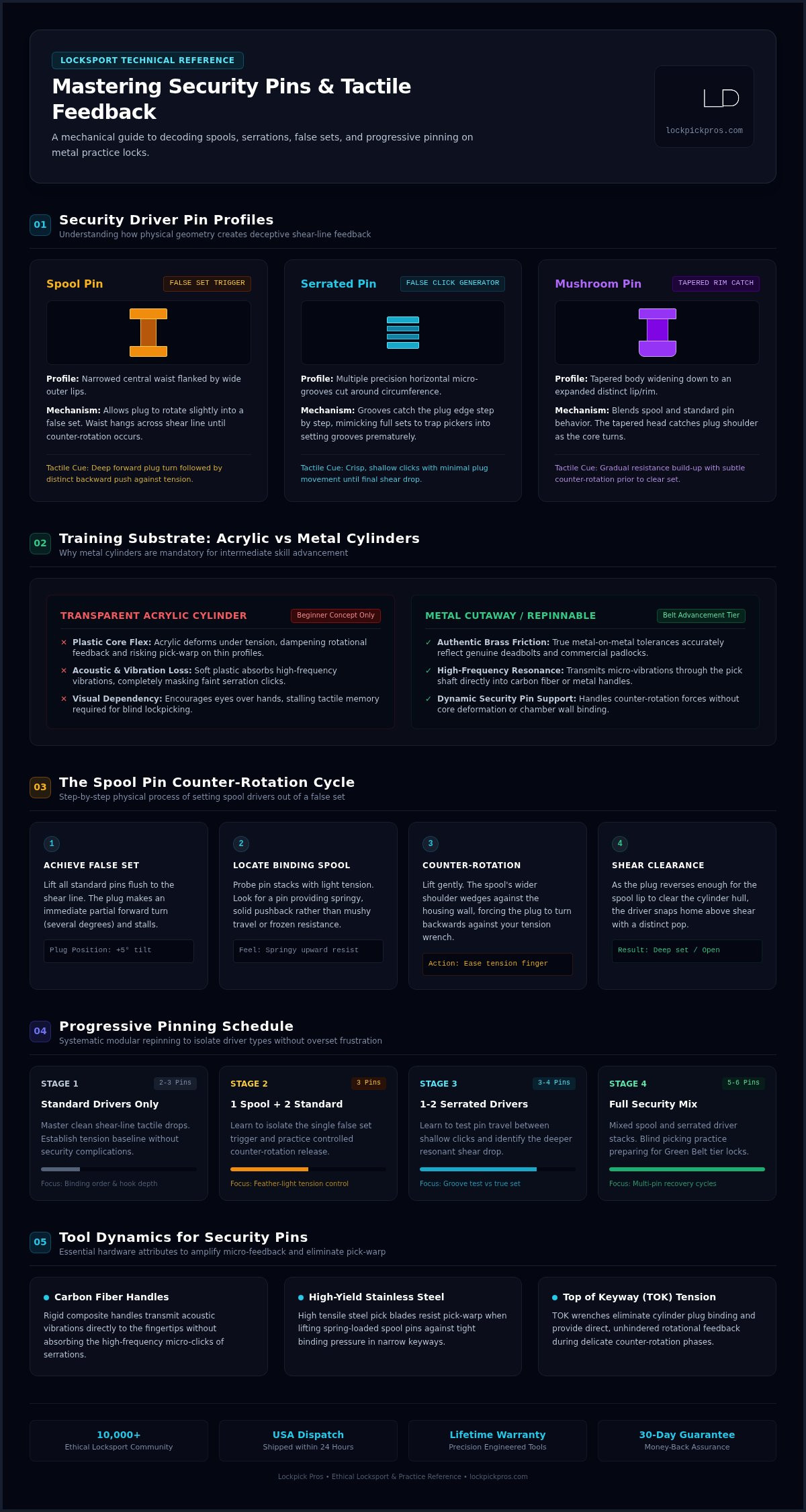
Security driver profiles dictate how mechanical forces travel down your pick shaft. A Spool pin features an undercut center waist flanked by wide outer lips. When lifted under rotational force, the plug slips into a partial turn known as a false set. Setting the pin requires working through counter-rotation, where the plug actively reverses direction against your tension wrench.
In contrast, serrated pins feature multiple micro-grooves cut into their circumference. Each groove generates a sharp, tactile click that feels deceptively identical to a true shear-line set. Picking these requires testing pin resistance between clicks to avoid setting a groove rather than the pin base. Mushroom drivers operate similarly to spools, blending a tapered body with a distinct rim that catches the plug shoulder as the core rotates.
Why Standard Acrylic Practice Locks Fall Short
Transparent acrylic cylinders serve well for understanding basic internal layout, but they hinder intermediate skill development:
- Plastic Core Flex: Acrylic deforms under standard tension, dampening rotation and triggering pick-warp on thin steel profiles.
- Acoustic and Vibrational Loss: Soft plastic absorbs high-frequency vibrations, masking the faint mechanical clicks serrations produce.
- Visual Crutches: Looking at exposed shear lines prevents your hands from developing the tactile memory needed to read feedback blind.
Transitioning to an authentic metal practice lock with security pins exposes your hands to genuine brass friction. To explore reliable starting gear, consider The Trainee 2.0 for fundamental hooks or the Carbon Fiber Special for rigid tactile transmission.
Decoding Tactile Feedback: False Sets and Counter-Rotation
Working through a practice lock with security pins shifts your focus entirely from visual cues to dynamic hand pressure. Security pins trap the core by catching outer lips against the housing. When this happens, heavy tension locks the cylinder solid, masking the delicate clues needed to open the mechanism. You have to listen to the plug.
A false set signals that every standard pin has cleared the shear line, leaving only security drivers suspended across the plug boundary. The cylinder plug suddenly rotates forward several degrees, yet the lock refuses to turn fully. Recognizing this deep tilt tells you the lock is primed for single pin picking.
Mastering the Spool Pin Counter-Rotation Cycle
Once the plug drops into a false set, the narrow center waist of a spool pin bridges the gap between the hull and the plug. Finding the binding spool requires feather-light tension:
- Probe each pin chamber with a standard hook until you find a pin offering springy, resistant pushback.
- Lift upward gently. The wider shoulder of the spool will wedge against the cylinder wall, forcing the plug to turn backward against your turning tool.
- Ease your tension finger intentionally. Let the plug reverse slightly so the spool waist clears the shear line before snapping home.
If you don't allow that backward rotation, the spool remains wedged, risking pick distortion or pin fatigue.
Navigating Serrated Pin False Clicks
Serrated pins create distinct hurdles. Each shallow micro-groove crossing the shear line yields a sharp, dry snap. Pickers often mistake these clicks for complete sets, leaving the driver stranded halfway between chambers. True shear alignment gives a noticeably deeper, resonant thud followed by micro-movement in the core.
Heavy turning pressure binds serration ridges against the cylinder wall, freezing the pin stack. Applying delicate tension lets you gauge whether a pin feels rigid or exhibits slight travel. You can discover foundational pin stacking concepts and assembly methods in our guide to lock rekeying for beginners.
Isolating these tiny rotational pulses requires responsive steel. Many hobbyists refine their sensitivity on a dedicated practice lock with security pins using the Carbon Fiber Gen 2 Pro Series, which pairs slim, durable profiles with handles designed to transfer vibrations straight into your fingertips.
Comparing Practice Lock Designs: Cutaway vs Repinnable Modular
Choosing the right practice lock with security pins comes down to balancing visible confirmation with pure mechanical feel. Once basic pin behavior makes sense, practicing on solid brass or aluminum replaces the mushy give of plastic with crisp tolerances. Your primary training platforms divide into two styles: open metal cutaways and fully repinnable blind cylinders.
Both styles bridge the transition between basic manipulation and high-security picking. However, they serve slightly different functions depending on whether you need immediate visual validation or rigorous blind decoding drills.
Metal Cutaway Lock Training Advantages
A metal cutaway lock features milled windows along the body and plug, exposing individual chambers while retaining realistic metal friction. When an aggressive spool catches stubbornly against the housing lip, a fast glance confirms your pick placement without breaking concentration.
- Realistic Friction: Real brass chambers deliver authentic binding behavior that plastic cannot replicate.
- Pin Diagnosis: Reveals whether you are stuck on a serration groove or battling an overset key pin.
- Targeted Feedback: Trains your fingers to pair the physical snap of counter-rotation with actual mechanical movement.
Repinnable Practice Cylinders for Infinite Drills
A blind modular cylinder strips away visual assistance, forcing complete reliance on tactile sensitivity. High-end training models use external grub screws on top of the bible. This design allows you to swap standard pins for serrated or spool variants in seconds using an Allen wrench, completely skipping the need to pull the core plug.
Modular cylinders excel at custom setups. You can load two chambers to master pure counter-rotation, then rebuild to six mixed chambers to simulate commercial deadbolts. If you are still putting together your workbench kit, take time to learn how to choose your first beginner lock pick set to match your tools to tight keyways.
Keep a dedicated pinning tray on your bench when configuring these cylinders. Organizing your drivers, key pins, and springs keeps the staging area clean, preventing accidental pin drops while you step up cylinder complexity. Choosing between these platforms depends on your immediate goal: cutaways diagnose persistent errors, while modular cylinders build the blind confidence required for ranked locks.
Progressive Pinning: A Step-by-Step Training Plan
Jumping into a five-pin commercial cylinder loaded with spools guarantees frustration. Progressive pinning breaks the learning curve down into manageable mechanical interactions. Using a dedicated practice lock with security pins to isolate specific driver designs removes guesswork, building reflex-level recognition before you tackle full stacks. This methodical workflow turns confusion into predictable muscle memory, paving an achievable path toward Orange and Green belt submissions in the community belt ranking system.
Progressive loading eliminates the constant oversetting that stalls intermediate progress. When you know precisely which pin varieties reside in each chamber, decoding plug behavior becomes an exact science rather than a game of chance.
Phase 1: Isolating Single Security Pin Stacks
Start with minimal chambers to eliminate distracting friction from neighboring pins:
- Load Two Chambers: Set up your practice lock with security pins using just one standard driver and one Spool pin.
- Apply Light Tension: Insert a flat pry bar tension wrench at the top of the keyway and apply feather-light rotational force.
- Decode Counter-Rotation: Lift the standard pin to set it. Once the plug drops into a false set, locate the spool and ease tension pressure as the cylinder reverses.
- Isolate Serrations: Swap the spool for a serrated driver. Practice identifying the distinct mechanical snap of a true set compared to the shallow clicks of intermediate ridges.
Phase 2: Graduated Complexity with a Pinning Tray
Keep your bench orderly by staging springs, key pins, and security drivers in the deep channels of a rubberized pinning tray. Expanding your setup chamber by chamber tests your ability to maintain plug control across mixed stacks:
- Three-Pin Configuration: Repin the cylinder with one standard pin and two spools. Notice how setting the second spool can occasionally drop the first pin, teaching you how to recover lost sets.
- Four-Pin Mixed Stacks: Advance to alternating serrated pins with spools across four chambers to master contrasting feedback cycles in a single picking attempt.
- Full Stack Benchmarking: Once you consistently open five mixed chambers blind, review the lock picking belt levels explained guide to measure your skills against Green Belt criteria.
To control tight plug rotations and prevent pick-warp as your chamber count climbs, upgrade your setup with the Carbon Fiber Gen 2 Pro Series for superior tactile feedback through every pin state.
Choosing the Right Picks and Tension Tools for Security Pins
Manipulating modified pin tumblers requires tools that transfer minute mechanical vibrations rather than absorbing them. A dedicated practice lock with security pins exposes your hands to subtle resistance changes, but spongy tools or awkward keyway angles can completely mute those signals. Equipping the proper hook profiles and turning tools ensures every click and plug shift translates directly into your fingers.
When tolerances tighten, tool geometry dictates whether you successfully set a pin or inadvertently overset its neighbors.
Tension Control: Top of Keyway vs Bottom of Keyway
Tension wrench placement fundamentally shapes how well you detect counter-rotation. Bottom of the keyway (BOK) wiper inserts frequently pinch against the bottom of the cylinder plug, creating artificial friction that mimics a binding pin. They also crowd the bottom of the keyway, restricting pick movement.
- Clear Pick Travel: Top of the keyway (TOK) flat pry bars sit at the upper edge, leaving the entire keyway open for pick navigation.
- Direct Rotational Readout: A rigid TOK pry bar provides immediate tactile feedback when a spool forces the cylinder backward.
- Zero Plug Binding: Proper TOK placement eliminates accidental housing drag, ensuring all felt resistance originates strictly from pin binding.
Maximizing Sensitivity with Carbon Fiber Handles
Soft rubber or bare plastic pick handles absorb high-frequency feedback, muffling the faint mechanical snaps produced by serrations. A rigid carbon fiber handle acts like an acoustic sounding board, channeling micro-vibrations straight from the pin tip to your grip without flex. Paired with high-yield stainless steel shanks, these stiff handles eliminate pick-warp when lifting against stubborn springs.
Read about the benefits of carbon fiber lock picks to see how composite materials elevate feedback. Hook selection also plays an essential role. A medium to deep hook profile reaches high-set spools hidden behind low-hanging key pins without oversetting them. For strategies on tackling tighter keyways, check out this advanced lock guide.
Equipping precision tools like the Carbon Fiber Gen 2 Pro Series ensures your gear matches the mechanical demands of high-security practice cylinders as you refine your technique.
Sharpen Your Senses for the Next Belt Rank
Mastering complex pin geometries comes down to intentional repetition and mechanical clarity. Moving away from plastic shells to train on a practice lock with security pins gives your hands the exact physical resistance needed to read subtle counter-rotation and decode shallow false clicks. Isolating pins progressively transforms confusing plug movements into reliable, repeatable muscle memory.
Over 10,000 ethical locksport hobbyists are already progressing through community belt challenges, conquering tighter tolerances one cylinder at a time. Advancing toward Green Belt ranks demands tools engineered to translate delicate pin behavior accurately. Precision picks built with rigid high-yield stainless steel eliminate pick-warp, while real carbon fiber handles transmit acoustic vibrations straight to your fingertips for instant tactile feedback.
Upgrade your feedback with the Carbon Fiber Gen 2 Pro Series today. Set up your training bench, trust the feel of the pins, and enjoy the satisfaction of conquering your next milestone lock.
Frequently Asked Questions
What makes a practice lock with security pins different from a standard training lock?
A practice lock with security pins contains specially machined driver pins like spools or serrations instead of uniform brass cylinders. Standard training cylinders set cleanly when pushed flush with the shear line. A security pin training lock intentionally snags, tilts the cylinder, and gives false feedback. This forces pickers to master counter-rotation and light tension control rather than simply lifting pins until they click into place.
Can security pins be picked using basic raking techniques?
Raking rarely opens locks containing security drivers because aggressive scrub movement catches the spool lips and serration ridges below the shear line. While a diagnostic hybrid approach might set one or two standard pins quickly, finishing the cylinder almost always demands single pin picking (SPP). You must isolate individual chambers, feel subtle pushback, and manually manage counter-rotation to let each security pin slide into place.
Why does the core rotate slightly before the lock actually opens?
That sudden rotation is called a false set. It occurs when all standard pins reach the shear line, but one or more spool pins remain trapped across the plug boundary. Because a spool has a narrow waist, the plug turns forward a few degrees until the wider lip hits the cylinder wall. A false set confirms progress and signals that you need to begin hunting for counter-rotation.
How do I know if I am oversetting a spool pin during practice?
Oversetting happens when the key pin pushes completely past the shear line into the upper chamber. If you lose your false set and the core goes completely rigid or all remaining pins feel suddenly loose and springless, you overset a pin. When this occurs, ease your tension wrench slightly until you hear a single click of the key pin dropping back down, then resume testing binding order.
Are clear acrylic locks good for learning spool and serrated pins?
Clear acrylic cylinders work fine for demonstrating basic internal concepts, but they fail when practicing security pins. Acrylic plastic absorbs acoustic clicks and flexes under rotational force, dulling subtle mechanical vibrations. Plastic also wears down quickly around the shear line. Dedicated metal practice cylinders provide authentic brass-on-brass friction, which is essential for building the muscle memory and tactile awareness needed for blind picking.
What tension wrench position works best for picking security pins?
Top of the keyway (TOK) tension is ideal for security pins. Inserting a flat pry bar into the top edge leaves the entire lower keyway open for your pick shaft, preventing accidental pin contact. More importantly, rigid TOK tools give an immediate, unfiltered readout of plug rotation. This crisp response makes it far easier to detect delicate spool counter-rotation without binding the cylinder housing.
Which belt ranking locks feature spool and serrated pins?
In the locksport belt ranking system, security pins appear officially at Orange Belt, which highlights basic spool mechanics in padlocks like the Master Lock 150 or ABUS 55/40. Green Belt locks step up complexity by introducing serrated pins and serrated spools in tight-tolerance cylinders like the American Lock 1100. Training on a practice lock with security pins prepares your hands for these exact milestones.