

The Ultimate Guide to Choosing a Lockpicking for Beginners Kit

Ready to dive into the exciting world of locksport? That first 'click' as the pins set and the core turns is an incredible feeling, but the path to get there can seem overwhelming. Staring at hundreds of tools, fearing you'll buy a cheap set that will just bend and break, and not knowing where to begin is enough to stop any aspiring picker in their tracks. That’s why choosing the right lockpicking for beginners kit isn’t just your first purchase-it’s the most critical step in your new hobby.
This guide is your roadmap. Forget the confusion and wasted money. We'll show you exactly which tools are essential for building your foundational skills, how to spot a quality set that will last, and whether you really need those practice locks. By the end, you’ll be able to pick the perfect kit with total confidence and start your locksport journey the right way. Let's get you picking!
Key Takeaways
- Discover the essential picks and tension tools that form the core of any great kit, and learn why most other tools are just filler.
- Learn how to spot the red flags of a low-quality set, so you can avoid the common beginner mistake of buying a huge kit full of useless tools.
- Define your personal goals to select the perfect lockpicking for beginners kit, ensuring you get the right tools for your specific locksport journey.
- Your kit has arrived-now what? Follow our simple first steps to start picking locks immediately and build momentum from day one.
What's Inside a Great Beginner Lockpicking Kit?
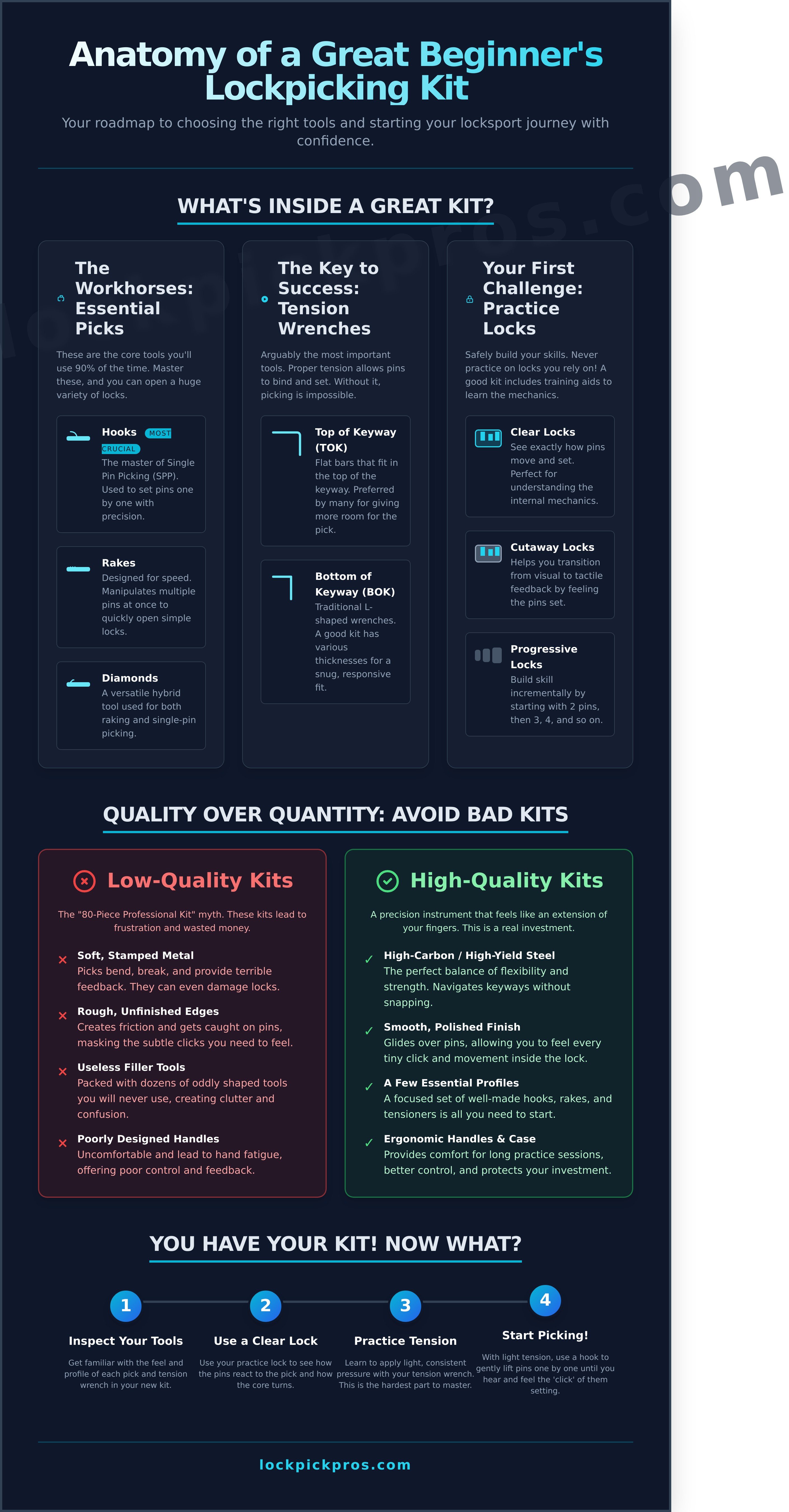
When you're searching for your first lockpicking for beginners kit, it’s easy to be drawn to sets with dozens of shiny tools. But here’s the secret: more isn't always better. A great beginner kit is a foundation for your skills, not a toolbox full of filler you'll never touch. The goal is to master the essentials-the tools you'll use 90% of the time on your journey into the sport of locksport. Let's break down the must-haves.
The Workhorses: Essential Lock Picks
These are the core tools that do the real work. While the history of lock picking shows a wide variety of tool designs, a few have become foundational for a reason. You only need a handful of high-quality picks to start opening locks and building real tactile skill.
- Hooks: Your most crucial pick. The hook is the master of single-pin picking (SPP), the art of setting each pin one by one. A short and medium hook will open the vast majority of beginner and intermediate locks.
- Rakes: These are for speed. Rakes are designed to manipulate multiple pins at once, allowing you to quickly open simple locks and get an early win.
- Diamonds: A versatile hybrid. The diamond can be used for both raking and picking individual pins, making it a valuable and flexible tool in your arsenal.
The Key to Success: Tension Wrenches
Often overlooked, the tension wrench (or tensor) is the most important part of your kit. It provides the slight rotational pressure that allows pins to bind and set. Without proper tension, even the best pick is useless. A good kit includes a variety of them.
- Top of Keyway (TOK): These flat bars fit in the top of the keyway, giving you more room for your pick. This is the preferred method for many experienced pickers.
- Bottom of Keyway (BOK): The traditional L-shaped wrenches apply tension to the bottom. Having various thicknesses is critical to get a snug, responsive fit in different locks.
Your First Challenge: Practice Locks
Rule number one of ethical locksport: never practice on locks you rely on or don't own. A quality lockpicking for beginners kit often includes safe, effective training aids to build your skills.
- Clear Locks: See exactly how the pins move and set as you manipulate them. Perfect for understanding the core mechanics.
- Cutaway Locks: These allow you to feel the pins set correctly without the visual crutch of a clear lock, helping you transition to real-world picking.
- Progressive Locks: Start with a lock with two pins, then move to three, four, and so on. This builds your skills incrementally and prevents frustration.
Quality Over Quantity: How to Spot and Avoid Bad Kits
When you're starting out, the biggest mistake you can make is falling for the allure of a massive, cheap kit. You see dozens of tools for a low price and think you're getting a great deal. This is the fastest way to get frustrated and quit. A quality lockpicking for beginners kit isn't about having the most tools; it's about having the right tools.
The '80-Piece Professional Kit' Myth
Those giant, budget-friendly sets are almost always a trap. They are packed with unusable filler-dozens of oddly shaped rakes you'll never use and duplicates of poorly made hooks. The metal is often soft and stamped, not milled. This means the picks will bend, break, and have rough, unfinished edges that get caught on pins, provide terrible feedback, and can even damage the locks you're trying to learn on.
What Defines a High-Quality Lock Pick?
Instead of a pile of junk, you need a few precision instruments. A great pick feels like an extension of your fingers, transmitting every tiny click and movement from inside the lock. This is what separates a quality tool from a cheap one. Here’s what to look for:
- The Material: Look for high-yield or high-carbon steel. This gives the pick the perfect balance of flexibility and strength, allowing it to navigate the keyway without snapping or permanently bending.
- The Finish: A professional pick is smooth and polished. Rough edges create friction and noise, masking the subtle feedback from the pins. A smooth finish glides over the pins, letting you feel exactly what's happening inside the lock, a concept detailed in resources like the famous MIT Guide to Lock Picking.
- The Profile: Quality picks often have a slimmer, more refined profile, allowing them to fit into more restrictive keyways without getting stuck.
- Ergonomic Handles: You'll be practicing for long sessions. Comfortable, purpose-built handles prevent hand fatigue and give you better control.
Why a Good Case Matters
Don't overlook the case! Your picks are precision tools, and a good case is essential for protecting your investment. It prevents your picks from getting bent or damaged while bouncing around in a bag. It also keeps your tools organized and accessible, so you can grab the exact hook or tensioner you need without digging through a pile. Look for durable materials like leather or ballistic nylon.
Choosing the Perfect First Kit for Your Goals
Not every newcomer to locksport has the same path. Are you a casual hobbyist looking for a new puzzle, or an aspiring champion aiming for the next belt ranking? Your goals and budget will determine the perfect starting point. This isn't about buying the most tools; it's about buying the right tools. Finding the right lockpicking for beginners kit is about balancing quality tools, essential practice aids, and price. Let's break down the three main pathways to getting your first set.
The All-in-One: Complete Starter Sets
For most people, this is the ideal entry point. A complete lockpicking for beginners kit removes the guesswork, giving you everything you need in one package. A quality set will include a curated selection of essential picks and, crucially, practice locks. Clear acrylic locks are great for seeing the mechanism, while cutaway locks provide a more realistic feel. These kits are designed to grow with you, providing the foundational tools to take you from your first open to more complex challenges.
See our recommended all-in-one beginner kits.
The Minimalist: A Foundational Pick Set
On a tighter budget or prefer to build your collection piece by piece? The minimalist path is for you. Focus on acquiring a small, high-quality set with just the essentials: a few fundamental hooks and a solid variety of tensioners. Prioritize both top-of-keyway (TOK) and bottom-of-keyway (BOK) tension tools to be prepared for different locks. This approach saves money upfront, but remember you will need to purchase practice locks separately to develop your skills.
The Enthusiast: Building Your Own Kit
If you've already spent hours watching videos and reading up on theory, you might be ready to build your own custom kit. This path offers maximum control, allowing you to hand-pick every hook, rake, and tension wrench. For those diving deep into the mechanics, resources like the famous MIT's guide to lock picking provide the technical foundation needed to make informed choices. It’s a bigger investment in time, but the payoff is a perfectly tailored toolkit from day one.
You Have Your Kit! Your First Steps to Picking a Lock
The unboxing is done and your new tools are laid out. It’s an exciting moment, but it can also be a little intimidating. Where do you even begin? Right here. This is where the fun starts and your locksport journey takes off. Follow these foundational steps to go from zero to your first open, building good habits from your very first practice session.
Getting the Feel: Handling Your Tools
Before you touch a lock, get comfortable with your tools. Hold your pick lightly but securely, much like you’d hold a pencil. Your tension wrench is your source of feedback. Practice applying light, consistent turning pressure to the lock’s core-this is the most critical skill to develop. As you practice, you'll start to understand the basic vocabulary:
- Pin Stack: The set of pins (a key pin and a driver pin) that must be separated to open the lock.
- Shear Line: The tiny gap between the inner plug and the outer housing. Your goal is to align the top of every key pin with this line.
- False Set: A small turn of the core that feels like an open but isn't. It's a sign you've encountered a security pin!
Your First Open: The Clear Practice Lock
The clear acrylic lock included in your lockpicking for beginners kit is your new best friend. Don't skip this step! Its transparent body allows you to see exactly how the internal mechanism works. As you apply tension and gently "rake" or "scrub" the pins with your pick, watch them lift and set at the shear line. This visual feedback is priceless for building a mental model of what’s happening inside a real lock.
Moving On: Graduating to Metal Locks
Once you can consistently open the clear lock in seconds, you're ready to level up. The skills you built are directly transferable. Move on to a cutaway lock if you have one, and then grab a simple, standard pin-tumbler padlock. Don’t get discouraged if it takes longer; every lock is a new puzzle. Remember, the best tools in any lockpicking for beginners kit are patience and practice. Keep at it, and you'll feel the incredible click of your first real open.
Ready for the next step? Dive deeper into technique. Read our full guide on How to Pick a Lock.
Your Journey into Locksport Starts Here
You're now equipped with the knowledge to make a smart choice on your first set of picks. This isn't just about buying tools; it's your entry into a fascinating new skill. Remember the core principles we've covered: prioritize high-quality, responsive tools over a massive, low-quality collection, and always choose a kit that aligns with your personal learning goals. By understanding what makes a great lockpicking for beginners kit, you can avoid the frustration of cheap tools and start your hobby with confidence.
This is where the real fun begins. Instead of settling for a generic set, you can invest in precision instruments that will grow with you from your first open to your first black belt lock. Every kit we offer is meticulously curated by locksport experts and forged from high-quality, high-yield steel. This commitment to quality ensures you get the precision and durability trusted by thousands of ethical lockpickers across the community.
Ready to start your journey? Explore our curated Beginner Lockpick Kits!
The world of locksport is a rewarding puzzle waiting to be solved. Grab your tools, be patient, and welcome to the community!
Frequently Asked Questions
What is the absolute minimum I need to start lockpicking?
To start your locksport journey, you only need two essential tools: a tension wrench and a hook pick. The tension wrench applies rotational pressure, while the hook lets you feel and set individual pins. While that's the bare minimum, we strongly recommend adding a clear practice lock to your first kit. This lets you see the internal mechanics and understand what you're feeling, which will dramatically speed up your progress from the very beginning.
Are expensive lock pick sets worth the money for a total beginner?
No, an expensive set is not necessary when you're just starting out. Large, complex kits can be overwhelming and often contain specialized tools you won't use for months. A high-quality lockpicking for beginners kit is a much better investment. It provides the foundational tools you need to learn core skills like single-pin picking without the extra cost or confusion. Focus on mastering the basics first, then expand your collection as you advance in your locksport journey.
How long will it take to learn lockpicking with a beginner's kit?
The time it takes to learn varies for everyone, but with consistent practice, you can get your first open within a few hours or days! The key is understanding the feedback the lock gives you. A good beginner's kit with a practice lock helps you build that fundamental feel much faster. Remember, locksport is a journey of skill refinement. Your first open is just the beginning of earning your next belt ranking in this amazing hobby.
Is it okay to practice on the locks in my own house?
We strongly advise against practicing on any lock that is currently in use, especially the ones in your own home. It is very easy for a beginner to accidentally break a pick inside the lock or damage the internal mechanisms. This could leave you with a non-functional lock and a costly call to a locksmith. Always use dedicated practice locks or old, discarded locks that you don't rely on. Practice smart and stay safe!
What is the main difference between a hook and a rake pick?
The main difference is precision versus speed. A rake is designed to quickly slide across all the pins, hoping to set them all at once through a technique called raking. It’s fast but works best on simpler locks. A hook is a precision tool used for single-pin picking (SPP), where you feel and set each pin one by one. Mastering the hook is essential for opening more complex locks and is a core skill for every ethical lockpicker.
Should my first kit include tools for security pins?
While not strictly necessary on day one, having tools for security pins in your first kit is a huge advantage. Most beginner locks have standard pins, but you will quickly encounter security pins like spools and serrated pins as you progress. A good lockpicking for beginners kit will include varied hook profiles that are effective against these challenges. This ensures your kit grows with you as you move up the locksport belt rankings and tackle more difficult locks.