

10 Essential Skills to Learn to Be More Self-Reliant in 2026
What if the next time a door jammed or a mechanism failed, your first instinct wasn't to call an expensive professional, but to solve the puzzle yourself? It's a frustrating reality for many that we've become overly dependent on outside services for basic repairs, often feeling helpless when things break. If you're tired of that "call for help" reflex, identifying the right skills to learn to be more self-reliant is the first step toward true independence. Mastering these abilities isn't just about saving money; it's about the deep confidence that comes from knowing you can handle whatever life throws your way.
We know that the journey from a curious beginner to a capable problem solver can feel intimidating at first. That's why we've mapped out a clear progression of mechanical and mental disciplines designed to build your competence one step at a time. This guide explores everything from basic tool proficiency to the intricate art of locksport, which transforms security hardware into a rewarding mental challenge. You'll discover a roadmap for skill progression that offers immediate utility and connects you with a community of independent thinkers who value mastery over convenience. Let's look at the essential tools and techniques you'll need to claim your black belt in self-reliance for 2026.
Key Takeaways
- Shift your mindset from a passive consumer to an active producer by prioritizing mechanical literacy and hands-on problem-solving.
- Master high-leverage household skills like basic carpentry and electrical safety to reduce dependence on expensive professional services.
- Discover why locksport is one of the essential skills to learn to be more self-reliant, building the manual dexterity needed to handle security hardware with confidence.
- Follow the structured belt ranking system to ensure a steady, burnout-proof progression from foundational White belt techniques to advanced mastery.
- Join the Black Belt Challenge and participate in the share-to-earn loop to document your progress and earn rewards while helping fellow hobbyists.
Redefining Independence: What It Means to Be Self-Reliant in 2026
Self-reliance in 2026 is more than just a buzzword; it's a total identity shift. It marks the move from being a passive consumer who waits for a technician to becoming an active producer who understands the mechanisms of daily life. When we look at What is Self-Reliance in a modern context, we see it's about reclaiming personal agency. Identifying the right skills to learn to be more self-reliant is the first step in this transformation. Mechanical literacy is now a vital partner to emotional resilience. If you can't navigate the physical world without a gatekeeper, you haven't achieved true independence. We treat this process as a journey of mastery, where every new skill adds a layer of confidence to your problem-solving toolkit.
The Shift from Consumer to Producer
Modern convenience has a hidden cost: it has caused our basic mechanical instincts to atrophy. Everything in our lives is "one-click," which hides the complexity of how things actually work. Reclaiming these instincts provides a massive psychological boost. Knowing "I can fix this" changes every interaction you have with your environment. In 2026, the generalist holds the ultimate advantage. While specialists are locked into a single lane, a self-reliant generalist can troubleshoot across multiple systems. This shift in perspective turns every broken device or stuck mechanism into a puzzle to be solved rather than a crisis to be managed. It's about moving from "I hope this works" to "I'll make this work."
The Three Pillars of Self-Reliance
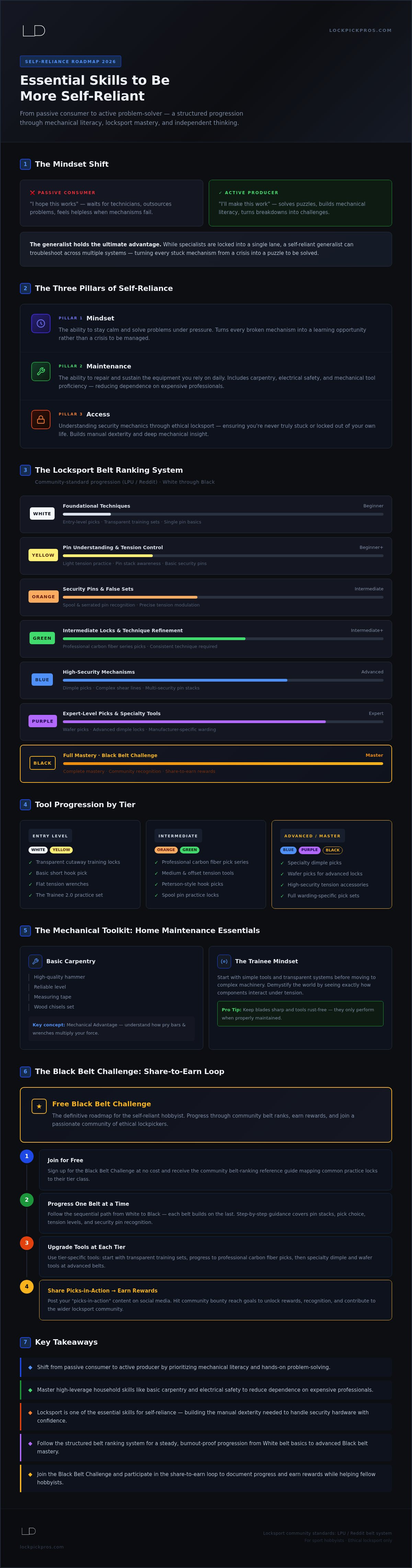
We view independence as a three-legged stool. If one leg is missing, the whole structure collapses. Mindset is your first pillar; it's the ability to stay calm and solve problems under pressure. Maintenance is the second pillar, representing your ability to repair and sustain the equipment you rely on daily. Finally, Access is the understanding of security mechanics and ethical locksport. This pillar ensures you're never truly stuck or locked out of your own life. For those ready to explore these mechanics, The Trainee 2.0 offers a hands-on way to start seeing how pins and springs interact under tension. Understanding these pillars allows you to build a foundation of technical knowledge that is both practical and empowering.
Are you ready to test your limits and track your progress? Join our free Black Belt Challenge today. It's the definitive roadmap for the self-reliant hobbyist. You'll progress through the community belt ranks, earn rewards by sharing your "picks-in-action" content, and join a passionate community of ethical lockpickers. Don't just read about independence; start your journey toward mastery right now and claim your first belt.
The Mechanical Toolkit: Essential Practical Skills for Home Maintenance
Building on the pillars of independence, we need to focus on high-leverage skills that save money and build foundational mechanical knowledge. When you're looking for the best skills to learn to be more self-reliant, home maintenance is a non-negotiable starting point. We advocate for a "Trainee" mindset. This involves starting with simple tools and transparent systems before moving to complex machinery. By understanding how basic mechanisms work, you demystify the world around you. For those looking to bridge the gap between theory and practice, The Trainee 2.0 provides an excellent entry point for mechanical exploration, allowing you to see exactly how components interact under tension.
Basic Carpentry and Structural Repair
You can't fix what you don't understand. Basic carpentry is about learning how things are built so you can identify exactly how they break. A self-reliant person should own a core set of reliable tools, including a high-quality hammer, a reliable level, a measuring tape, and a set of wood chisels. Maintenance is vital; keep your blades sharp and your tools free from rust to ensure they perform when needed. In the context of lever-based tools, Mechanical Advantage is the factor by which a mechanism multiplies the force or torque applied to it. Understanding this concept allows you to use tools like pry bars or wrenches to overcome physical obstacles that would be impossible to move with raw strength alone.
- Leveling and Alignment: Ensuring doors and frames are square to prevent sticking.
- Fastener Knowledge: Choosing the right screw or bolt for the specific material and load.
- Structural Integrity: Identifying weight-bearing components versus cosmetic finishes.
Electrical and Plumbing Fundamentals
Electrical safety and plumbing fundamentals are the backbone of a self-sustaining home. Following a comprehensive list of Essential Home Maintenance Skills can help you track these systems regularly. Safe troubleshooting is about knowing your limits. Swapping a light switch or replacing a faucet washer are great trainee-level tasks, but rewiring a main breaker box requires professional intervention. Understanding flow systems, such as how water moves through pipes or electricity through a circuit, removes the mystery from home failures. These skills to learn to be more self-reliant often require specialized tools to navigate specific mechanical obstacles, such as pipe wrenches or multimeters.
Once you've mastered these foundational household repairs, you'll find that your manual dexterity and problem-solving abilities have significantly improved. To further refine your tactile feedback and precision, consider upgrading your gear to professional-grade carbon fiber tools which offer superior strength and sensitivity for more intricate mechanical puzzles.
The Access Pillar: Why Locksport is a Vital Self-Reliance Skill
While the previous sections focused on general maintenance, the Access Pillar addresses the specific mechanical obstacles that can halt your progress. Locksport is the legitimate, community-driven hobby of understanding and bypassing these barriers through skill and precision. It is one of the most technical skills to learn to be more self-reliant because it replaces the panic of a lockout with the calm analysis of a problem solver. By treating security hardware as a puzzle, you gain manual dexterity and a deep understanding of the mechanisms that protect your world. This journey starts with an ethical commitment: we only practice on locks we own or have explicit permission to open, ensuring a responsible and supportive community culture.
Understanding Physical Security Mechanics
The fundamental mechanical puzzle is the pin tumbler lock. To understand its vulnerabilities, we often start with a foundational White Belt lock like the Master Lock #3. This lock features a 4-pin stack with all standard pins and relatively wide tolerances. To pick it, apply light to medium tension with a bottom-of-the-keyway wrench. Using a standard short hook, probe the pins from front to back. Identify the "binding" pin; it will feel stiffer than the others. Gently lift that pin until you hear a distinct click and feel the plug rotate slightly. Repeat this for the remaining pins until the shackle releases. This process teaches you more about physical security than any manual could, showing you exactly how mechanical tolerances affect the integrity of a lock.
Developing Patience and Precision
Single pin picking (SPP) is the ultimate test of focus. It requires you to manipulate each pin individually, which builds the fine motor skills necessary for high-level self-reliance. When you begin your pick set selection, we recommend starting with a kit that includes a variety of hooks and tension tools to accommodate different keyways. You can find detailed guidance in our article on How to Choose Your First Beginner Lock Pick Set. Mastering SPP provides that "Aha!" moment when the plug finally turns, signaling that your patience and tactile feedback have overcome a mechanical barrier. It's a milestone that builds the confidence needed to tackle more complex systems in the future.
Are you ready to turn these theories into action? Join our free Black Belt Challenge today. This program allows you to join the challenge for free, progress one belt at a time, and upgrade your tools at each tier as the puzzles get harder. Share your "picks-in-action" content on social media to earn community rewards and even participate in our community bounty for hitting social reach goals. Start your progression now and see how far your new skills can take you.
The Mental Framework: Problem-Solving and the Belt Ranking System
Vague goals like "becoming more independent" often lead to frustration because they lack a concrete way to measure progress. In the locksport community, we solve this through a structured curriculum that turns abstract theory into technical mastery. Following the community-standard belt ranks is one of the most effective skills to learn to be more self-reliant because it teaches you how to break down intricate mechanical problems into manageable, sequential steps. By respecting the progression from simple pin stacks to high-security cylinders, you build a foundation of problem-solving discipline that applies to every area of your life.
Progressive Practice: From Yellow Belt to Green Belt
Once you've mastered the basic padlocks discussed earlier, the next step in your progression is the Master Lock 140 (Yellow Belt). This lock features a 4-pin stack and typically includes at least one spool pin designed to trap your pick in a false set. To successfully pick it, use a standard hook pick and medium bottom-of-keyway tension. If the plug rotates slightly but the lock doesn't open, you've likely caught a spool. Ease off the tension wrench slightly while applying upward pressure on the binding pin; you'll feel "counter-rotation" as the pin clears the shear line. This stage is vital for developing the tactile sensitivity required for intermediate practice locks.
Transitioning to the American Lock 1100 (Green Belt) represents a significant jump in difficulty. This lock utilizes a 5-pin stack filled with serrated driver pins and serrated spools. We recommend using a .050" top-of-keyway tension wrench and a professional hook pick in .018" thickness. Apply very light tension and listen for the distinct "clicks" as you move through each serration. If you enter a deep false set, identify the pin providing counter-rotation to set the spool. Be aware that the core spring in an 1100 is quite heavy; the lock may actually be open even if the plug hasn't turned fully. To understand the full roadmap of these challenges, check out our guide on Lock Picking Belt Levels Explained.
High-Security Mastery: The Advanced Tiers
As you reach the advanced tiers, you'll encounter "Black Belt" locks that define the peak of mechanical security. These locks often feature complex sidebars, serrated pins, and mushroom pins with extreme tolerances. A False Set is a milestone in a picker's journey where the plug rotates significantly but is held back by the lip of a security pin; it confirms you've successfully navigated the standard pins and are now engaging the core security features. At this level, your gear must evolve. Specialty tools like dimple picks or wafer picks become necessary to navigate telescopic pins and unique keyway obstacles. Transitioning to a professional carbon fiber series provides the superior feedback needed to interpret these advanced mechanical puzzles.
Are you ready to claim your place in the community? Join our free Black Belt Challenge today. You can join the challenge for free, progress through each of the belt ranks at your own pace, and upgrade your tools as your skills sharpen. Share your "picks-in-action" content on social media to earn community rewards and help us hit our community bounty for social reach. Start your journey toward mastery now and turn the world's most difficult locks into solved puzzles.
Your Path to Mastery: Starting the Black Belt Challenge
The journey toward independence is not a solo mission. While the technical skills to learn to be more self-reliant begin with individual practice, they are solidified through community engagement and shared knowledge. We've designed the Black Belt Challenge as the ultimate roadmap for the modern hobbyist. It isn't just a list of locks; it's a structured path that turns abstract goals into tangible achievements. By joining this challenge, you're committing to a process of constant improvement, moving from the basic mechanics of a trainee to the precision of a master.
Our community thrives on a "Share-to-Earn" loop. This system encourages you to document your progress and help others who are just starting their journey. To foster this spirit of growth, we've established a community bounty for hitting social reach goals. When our collective "picks-in-action" content reaches more people, everyone in the community earns rewards. It's a way to ensure that as you grow in your personal self-reliance, you're also lifting up the hobbyists around you.
The Share-to-Earn Community Loop
Recording your first "pick-in-action" video is a rite of passage. By documenting your success on a White Belt level lock, you aren't just proving your skill; you're providing a visual guide for the next person in line. Community validation is a powerful motivator. When you share your videos, you earn rewards that can be used to upgrade your toolkit as you advance through the tiers. This loop creates a responsible locksport culture where ethical sharing is the standard. Helping a beginner navigate their first pin stack is just as rewarding as opening a high-security cylinder yourself.
Join the Black Belt Challenge Today
You can sign up for the free Black Belt Challenge right now to start tracking your progression. We recommend setting a clear 30-day goal: earning your White Belt. This foundational step proves you've mastered the basic skills to learn to be more self-reliant and are ready for more complex mechanical puzzles. As the locks get harder, you'll need tools that offer better feedback and tighter tolerances. The Carbon Fiber Gen 2 Pro Series is the definitive kit for those serious about reaching the higher tiers. It provides the professional-grade sensitivity required to feel the subtle movements of security pins.
Don't stay a passive observer. Take the first step toward mechanical mastery by securing the right equipment and joining a community of like-minded problem solvers. Start your professional journey with the Carbon Fiber Gen 2 Pro Series and claim your place among the ranks of ethical, self-reliant pickers today.
Your Journey Toward Total Independence Starts Now
The year 2026 is about reclaiming your agency by shifting from a passive consumer to an active producer. We've explored how mechanical literacy and the access pillar form the foundation of a truly independent life. By focusing on the right skills to learn to be more self-reliant, you move past the frustration of being locked out of your own world. You've seen how the structured belt ranking system ensures steady progress without the risk of burnout.
Now it's time to put that knowledge into practice. Join our free Black Belt Challenge to track your growth and join a community of ethical hobbyists. You can even share your "picks-in-action" on social media to earn community rewards while helping others. Mastery requires the right gear to feel every pin movement. Master the Access Pillar: Get the Carbon Fiber Gen 2 Pro Series and start your climb toward the black belt today. We're excited to see your progress and welcome you into the locksport family.
Frequently Asked Questions
Is lockpicking a useful skill for preppers and self-reliant people?
Yes, lockpicking is a foundational component of the Access Pillar. It transforms how you interact with your physical environment. Instead of being helpless during a lockout, you gain the ability to troubleshoot mechanical security puzzles. It is one of the most practical skills to learn to be more self-reliant because it ensures you aren't dependent on outside services for entry to your own property or equipment.
Is it legal to own a lockpick set for practice at home?
Owning lockpicking tools is legal in most parts of the United States for ethical hobbyists. Our community follows a strict code: only pick locks you own or have explicit permission to open. Using tools for practice at home is a legitimate part of locksport. We always recommend checking your local and state regulations to ensure you remain compliant while building your skills to learn to be more self-reliant.
How long does it take to learn the basics of single pin picking?
You can often learn to open your first basic padlock within a few hours of focused practice. Using transparent practice locks helps you visualize the pin stack and understand the binding order. While the fundamentals of single pin picking come quickly, achieving higher belt ranks takes consistent practice over months or years. The journey from a White belt to a Black belt is a marathon, not a sprint.
What is the "Black Belt Challenge" in the lockpicking community?
The Black Belt Challenge is our core engagement tool and a structured roadmap for your progression. It mirrors the community-standard belt ranking system, guiding you from simple padlocks to high-security cylinders. You start as a White belt trainee and work your way up by mastering increasingly difficult locks. This system provides clear milestones and prevents the burnout that often comes with unstructured learning in the locksport hobby.
Can I learn self-reliance skills if I am not naturally "handy" with tools?
Absolutely. Mechanical literacy is a learned ability rather than an innate talent. We encourage a "Trainee" mindset, where you start with simple tools and transparent systems to build your confidence. By breaking down complex problems into smaller parts, anyone can develop the manual dexterity needed for locksport. Independence is a journey of mastery that begins with the willingness to try your first mechanical puzzle.
What tools do I need to start my journey toward being more self-reliant?
To begin, we recommend starting with high-quality beginner lockpick sets and a few transparent practice locks. These tools allow you to see the internal mechanics while you learn. You'll also need a variety of tension wrenches to handle different keyways. As you advance, you might expand your kit to include bypass tools or specialty picks, but a solid foundational set is all you need to begin your journey.
How does the "share-to-earn" loop work for Lockpick Pros customers?
The share-to-earn loop is designed to foster a supportive community of ethical pickers. You record a "pick-in-action" video of yourself successfully opening a lock and share it on social media. By documenting your progress, you earn community rewards and help other beginners learn. There is even a community bounty for hitting social reach goals, which encourages everyone to participate and grow the sport of locksport together.
Why is carbon fiber better than standard steel for advanced lockpicking?
Carbon fiber is superior for advanced picking because it provides unmatched tactile feedback. In high-security locks, you need to feel the subtle clicks of serrated or mushroom pins. Carbon fiber tools are stiffer and more sensitive than standard steel, allowing those vibrations to travel directly to your fingertips. This level of precision is essential for anyone pursuing expert-level belt ranks and mastering the most complex mechanical security obstacles.