

Satisfying Hobbies to Master at Home: A Guide
What if your next favorite hobby didn't require a screen, a gym membership, or a massive upfront investment? Many of us spend our free time scrolling through digital feeds, only to end the day feeling like we haven't actually achieved anything. It's frustrating to feel unproductive when you finally have a moment to yourself. If you're searching for satisfying hobbies to learn at home, you're likely looking for something that offers a tangible sense of progress and a clear "win" state. You want a skill that challenges your hands as much as your mind.
This guide will help you transform your downtime into a journey of skill, progression, and the ultimate satisfaction of a puzzle solved. We're diving into the world of locksport, an ethical and community-driven hobby where you'll learn to master mechanical challenges one pin at a time. We'll show you how to start with foundational tools, follow the community's belt ranking system, and join a group of passionate enthusiasts who celebrate every successful open. From selecting your first practice locks to earning your stripes, you're about to discover a path from absolute beginner to expert-level mastery.
Key Takeaways
- Discover why the "mechanical solve" provides a deeper level of satisfaction than digital entertainment by engaging your tactile senses and focus.
- See why locksport is among the most satisfying hobbies to learn at home, offering clear win states and measurable skill progression.
- Master the community belt ranking system to turn your practice sessions into a structured journey toward becoming a Black Belt picker.
- Identify the specific tool upgrades needed at each tier, ensuring you have the precision of carbon fiber lockpicks when tackling advanced security pins.
- Learn how to join the Black Belt Challenge and share your progress with a supportive, global community of ethical hobbyists.
The Psychology of a Satisfying Hobby: Why the "Solve" Matters
Why do we seek out satisfying hobbies to learn at home? It's about "the solve." This is the specific moment when a complex mechanical or mental problem finally yields to your unique skill set. It isn't just about finishing a task; it's about the breakthrough. When you finally feel a mechanism give way or a puzzle piece click into place, your brain recognizes that your practice has paid off. This transition from confusion to clarity is what makes a hobby stick.
When you engage in tactile hobbies, you enter what researchers call the psychology of optimal experience. In this state, your stress fades and your focus sharpens. For a hobbyist, flow state is the mental zone where a mechanical puzzle becomes the only thing that exists. This deep immersion is the perfect antidote to the mental fatigue of a long workday. Locksport, or lockpicking as a sport, fits this profile perfectly because it requires your full attention and rewards it with immediate results.
The Dopamine of Tactile Feedback
Passive entertainment like streaming movies or scrolling social media provides a quick hit of dopamine, but it lacks the weight of achievement. Active, skill-based hobbies offer something better: tactile feedback. When you're working with your hands, every physical "click" or "pop" of a mechanism sends a signal to your brain that you're winning. This is why locksport is so addictive. It's a sport built on these tiny, physical victories that you can feel through your tools. You aren't just watching a story; you're the one making the story happen.
From Frustration to Mastery
If a hobby is too easy, you'll get bored. If it's too hard, you'll quit. The most satisfying hobbies to learn at home sit right in the middle. You need a challenge that forces you to grow. Many beginners hit a "beginner wall" where the initial excitement fades and the real work begins. Overcoming this hurdle is what builds genuine pride. In the locksport community, we use a belt ranking system to make this progression visible and manageable.
A clear path to mastery includes:
- Foundational Learning: Starting with basic tools like The Trainee 2.0 to learn the basics of pin stacks.
- Skill Refinement: Moving to advanced security pins that require more delicate tension.
- Tool Upgrades: Transitioning to professional gear like the Carbon Fiber Gen 2 Pro Series as your sensitivity improves.
- Ethical Pride: Practicing only on your own locks in a legal setting to foster a sense of responsibility and community trust.
This journey from trainee to expert creates a sense of mastery that few other home activities can match. It turns your downtime into a productive pursuit of excellence.
Tactile Mastery: Creative Hobbies for Hand-Eye Coordination
Many people start with generic crafts, but the most satisfying hobbies to learn at home are those that demand precise hand-eye coordination. Woodcarving and whittling allow you to create something from nothing using just a piece of wood and a sharp blade. It's a slow, methodical process that rewards patience. Similarly, electronics and soldering offer a unique thrill. There's a specific rush when you complete a circuit and see a device come to life for the first time.
For those who love detail, model building requires extreme focus. Whether it's a historical ship or a complex engine kit, the precision of fine assembly keeps your mind sharp. Eventually, many hobbyists find that these skills naturally lead toward mechanical puzzles and locksport. These activities share a common thread: the mastery of physical mechanisms and the development of a "feel" for how internal components interact.
The Precision of Fine Motor Skills
Hobbies that require steady hands are often the most rewarding because they provide a direct feedback loop. You don't need a massive garage to start. You can set up a small "mastery station" on a desk or even a kitchen table. In a limited apartment space, organization is key. Keep your tools in a dedicated case to maintain focus. High quality tools significantly shorten the learning curve. If your picks or blades are flimsy, you'll fight the equipment instead of learning the skill. This is why many in our community emphasize starting with gear that provides clear tactile communication.
Building Your First Home Workshop
Your first workshop doesn't need to be expensive. Safety is always the priority, so invest in eye protection and proper lighting before anything else. Set realistic goals for your first month. Don't expect to build a masterpiece or pick a high security lock on day one. Focus on foundational movements and understanding the physics of your chosen craft. If you're leaning toward the mechanical side of things, learning how to choose your first beginner lock pick set is a great place to start your journey.
As you progress, you'll find that the feedback from your tools becomes clearer. Joining the locksport community allows you to share these victories with others who appreciate the technical challenge. Moving from entry level gear to professional equipment like the Carbon Fiber Gen 2 Pro Series can transform your experience. These tools provide the precision needed for advanced challenges and help you reach that next level of mastery in your satisfying hobbies to learn at home.
The Art of the Open: Why Locksport is the Ultimate Indoor Puzzle
If you're looking for satisfying hobbies to learn at home, locksport offers a unique combination of mechanical engineering and sensory puzzles. Unlike digital games, this is a tactile challenge that exists in the physical world. We call it "The Art of the Open." It's the competitive and ethical hobby of picking locks for sport. You aren't just trying to bypass a device; you're trying to understand it. Every successful open provides an immediate, audible reward. That metallic "click" and the sudden turn of the plug offer a rush of dopamine that few other hobbies can match.
The real magic happens when you develop your "mental map." Since you can't see inside the lock, you learn to "see" the mechanism using only your sense of touch. You'll feel the pick tip slide across the pins and sense the tiny vibrations through the tension wrench. This visualization skill turns a simple piece of hardware into a complex, multi-layered riddle. However, being a part of this community means following a strict ethical code. We never pick a lock we don't own, and we never pick a lock that is currently in use. This keeps the sport focused on skill and respect for the craft.
Single Pin Picking (SPP) for Beginners
Most newcomers start with Single Pin Picking, or SPP. This technique involves lifting one pin at a time until the lock opens. You'll need to find the "binding order," which is the specific sequence the pins must be set in due to tiny manufacturing imperfections. One pin will always feel stiffer than the others; that's your starting point. For those just entering the "White Belt" phase, transparent training sets are essential. They allow you to verify what your fingers are feeling. A foundational kit like The Trainee 2.0 is perfect for building these initial muscles and understanding pin-tumbler mechanics.
The Feedback Loop: Tension and Feel
Mastering tension is the hardest part of the journey. Beginners often use too much force, which jams the pins and makes the lock impossible to open. Heavy tension is sometimes needed to find a binder, but light tension is required for delicate "security pins." You'll eventually encounter spools and serrated pins designed to trick you. Spool pins, for example, cause "counter-rotation" where the plug tries to turn backward as you lift. Learning to dance with these forces is what separates a trainee from an expert. If you're curious about the tools required for these advanced maneuvers, check out our guide on what is in a beginner lock pick set to see the anatomy of a professional kit.
This progression makes locksport one of the most satisfying hobbies to learn at home. You start with a clear view and slowly move toward the dark, relying entirely on your refined sense of touch.
Turning Skills into Ranks: The Power of Progression Systems
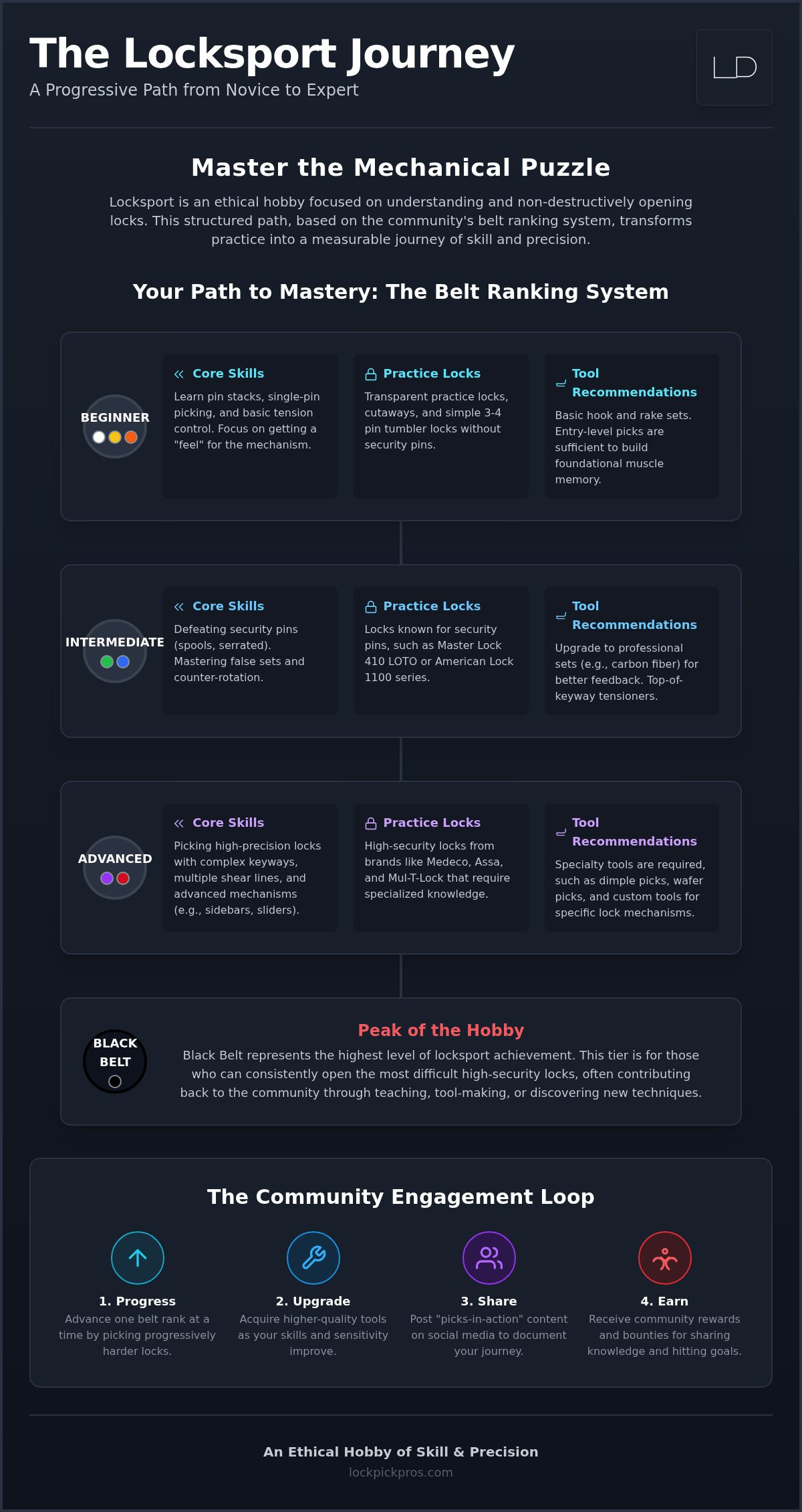
One reason many hobbies lose their spark is the lack of a clear finish line. When looking for satisfying hobbies to learn at home, you want a path that recognizes your growth. Locksport provides this through a formalized belt ranking system. It mirrors martial arts, starting at White and ending at Black. This structure provides a psychological anchor. You aren't just picking a lock; you're earning your next rank. This sense of progression keeps you motivated when the puzzles get tougher.
The standards aren't arbitrary. The global community on Reddit (r/lockpicking) and LPU (Lock Picking United) maintains rigorous lists that categorize thousands of locks by their mechanical complexity. Documenting your skill to hit these benchmarks creates a genuine sense of accomplishment. It turns your living room into a training hall where every successful open is a verified step toward mastery. Earning your next tier through documented skill provides a psychological boost that passive activities simply can't match.
White to Green: The Beginner Progression
The journey starts with simple, non-security pin locks. A Master Lock #3 is a classic White belt challenge. Once you master that, you move to locks with tighter tolerances or basic security pins like the Abus 55/40. The transition from clear acrylic practice locks to real-world metal cylinders is a major milestone. It forces you to rely entirely on tactile feedback rather than sight. This shift is where the hobby truly begins to feel like a sport. For a complete roadmap of which locks fit which tier, check out our guide on lock picking belt levels explained.
The Share-to-Earn Community Loop
Progression is more fun when it's shared with fellow enthusiasts. To earn your belt, you often record "picks-in-action" videos for verification by community moderators. This documentation ensures the integrity of the sport and allows others to learn from your technique. We encourage this through a share-to-earn loop. You can earn rewards and community bounties by hitting social reach goals when you post your progress online. This fosters engagement and helps the ethical lockpicking community grow.
The ultimate goal for many is the Black Belt Challenge. This isn't just about picking high-security locks. It involves making your own tools, gutting locks to show their internal components, and contributing back to the community. As you move into the intermediate Green and Blue belts, your feedback requirements change. You'll need the precision found in the Carbon Fiber Gen 2 Pro Series to feel the subtle movements of security pins. This equipment becomes your partner in the quest for the next rank.
Your First Win: How to Start Your Home Mastery Journey
Ready to turn your downtime into a journey of mastery? Finding satisfying hobbies to learn at home is about more than just buying gear. It's about creating an environment where you can succeed. Start by setting up a dedicated practice space. You need bright, direct lighting on your lock's keyway to see what you're doing. Maintain a relaxed posture with your elbows supported to avoid muscle fatigue. Most importantly, bring plenty of patience. Your first open might take five minutes or fifty, but the moment that plug turns, you'll be hooked on the mechanical solve.
Selecting your first tools is a critical step for any beginner. While a basic set gets you through the White belt phase, you'll quickly notice the limitations of entry-level steel. As the pins get smaller and the springs get tighter in more advanced locks, you need tools that don't damp the feedback. Professional gear ensures you're fighting the lock's complexity rather than your own equipment.
The Intermediate Upgrade: Carbon Fiber Precision
Once you hit the Yellow and Orange belt tiers, precision becomes your best friend. Upgrading to the Carbon Fiber Gen 2 Pro Series is a game-changer for intermediate hobbyists. These tools are built with high-quality steel that transmits vibrations directly to your fingertips. This allows you to feel the subtle click of a setting pin or the mush of an overset pin much more clearly. For a deep dive into why this material is the industry standard for locksport, read our guide on the benefits of carbon fiber lock picks.
Joining the Black Belt Challenge
Mastery is a journey best shared with a community. Our ecosystem thrives on the share-to-earn loop. It's simple. Join the Black Belt Challenge for free and start documenting your progress one belt at a time. As you level up, share your picks-in-action content on social media. By participating in our community bounty program, you can earn rewards for hitting social reach goals and helping others discover the sport. This fosters a culture of ethical, skilled hobbyists who support each other's growth.
Don't stay a trainee forever. Get your Carbon Fiber Gen 2 Pro Series and start the challenge today! Transform your free time into a pursuit of excellence and earn your place among the masters of the open. It's one of the most rewarding and satisfying hobbies to learn at home, and your first big win is just one click away.
Start Your Journey Toward Mastery
You now have the roadmap to move from a curious beginner to a skilled locksport enthusiast. We have explored how the psychology of the "solve" creates a deep sense of focus and why the community belt ranking system keeps your motivation high. By choosing ethical practice on your own locks, you become part of a global movement that values skill, patience, and technical precision.
Locksport is truly one of the most satisfying hobbies to learn at home because every successful open is a measurable victory. You can join our free Black Belt Challenge today to start your progression through the ranks. To ensure you have the precision engineered feedback required for intermediate security pins, Master the "Solve" with the Carbon Fiber Gen 2 Pro Series.
It's time to stop scrolling and start picking. Your first "click" is waiting, and the entire community is here to celebrate your progress. Welcome to the sport.
Frequently Asked Questions
What are the most satisfying hobbies to learn at home for beginners?
Locksport, woodcarving, and electronics are top choices because they offer clear "win" states. Locksport is particularly effective because it turns a physical mechanism into a mental puzzle you solve with tactile feedback. These satisfying hobbies to learn at home provide a sense of mastery that grows with every new challenge. They're far more rewarding than passive entertainment because they require active skill development and focus.
Is lockpicking a legal hobby to learn at home?
Yes, lockpicking is a legal and legitimate hobby known as locksport, provided you follow a strict ethical code. You must only practice on locks that you own and that aren't currently in use. It's vital to stay within these boundaries to maintain the integrity of the community. Ethical lockpickers treat every mechanism as a technical puzzle rather than a security bypass, focusing entirely on the sport.
What tools do I need to start learning locksport?
Beginners should start with a basic pick set and a few practice locks. A foundational kit typically includes hooks, rakes, and tension wrenches to handle simple pin-tumbler mechanisms. Transparent training sets are excellent for White Belt trainees because they allow you to see the internal movement of the pins. As you progress toward Yellow or Orange belts, you can upgrade to professional gear like carbon fiber lockpicks for better feedback.
How long does it take to get a "White Belt" in lockpicking?
Most hobbyists can earn their White Belt within their first few practice sessions. This rank requires successfully picking a basic lock, such as a Master Lock #3 or a transparent training cylinder. While the initial open might happen in minutes, true mastery involves understanding the binding order and pin stacks. This early win provides the immediate satisfaction needed to keep you motivated as you advance through more difficult tiers.
Can I learn satisfying technical hobbies without a lot of space?
You don't need a workshop to master satisfying hobbies to learn at home. Technical skills like locksport and electronics can be practiced on a small desk or even a kitchen table. A compact carrying case and a pinning tray help keep your tools organized in limited apartment spaces. The focus is on fine motor skills and mental concentration rather than heavy machinery, making it ideal for home learning.
What makes a hobby "satisfying" compared to just "fun"?
A satisfying hobby offers a "solve" and measurable progression, while fun is often just temporary entertainment. Satisfaction comes from overcoming a specific difficulty through skill refinement. In locksport, the physical click of a set pin provides dopamine-driven feedback that proves your technique worked. This sense of achievement builds long-term interest because you can see yourself leveling up from a trainee to an expert-level master of the craft.
How do I join the Black Belt Challenge for lockpicking?
You can join the Black Belt Challenge for free by following the community-standard ranking system. Start at the White Belt level by picking a basic lock and documenting your success for verification. As you move toward the Black Belt, the requirements become more technical, involving high-security locks and tool making. It's a structured journey that encourages you to share your picks-in-action with the global community for support and recognition.
What is the "share-to-earn" loop in the locksport community?
The share-to-earn loop is a community program that rewards you for documenting your locksport journey. When you share your successful opens and belt rank progress on social media, you can earn rewards and community bounties. This system encourages hobbyists to support each other while hitting social reach goals. It turns an individual practice session into a collaborative experience that helps the ethical lockpicking community grow and thrive together.