

City Rake: Tactical Guide for Ethical Lockpickers (2026)
The city rake is often dismissed as a "luck tool" by those who haven't mastered its rhythm, but it's actually one of the most efficient diagnostic instruments in an ethical lockpicker's kit. You've probably felt that familiar frustration when a standard scrub rake over-lifts every pin in the stack, leaving you with a mushy mess and no open. It's a common hurdle for hobbyists who are trying to move past the basics and earn their next belt. Understanding exactly when to use a city rake can transform your approach from blind guessing into a tactical strike.
We know how annoying it is to lose that tactile feedback through a metal handle or feel confused by the different motions required for various rake profiles. This guide promises to change that. You'll learn the precise mechanics of the rocking motion and how to use this tool to map out a lock's internals before you ever pick up a hook. We're going to cover how to improve your speed for lower-belt locks and use the city rake as a primary diagnostic step in your locksport journey. Let's get those pins set and your skills refined for the challenge ahead.
Key Takeaways
- Identify the city rake by its jagged L-profile and learn how it mimics the biting of a real key to set multiple pins at once.
- Understand exactly when to use a city rake to speed through standard pin-tumbler locks in the White and Yellow belt tiers.
- Master the rocking and scrubbing techniques to get better tactile feedback and avoid common over-lifting frustrations.
- Learn to use raking as a diagnostic step to identify spool pins and serrated pins that require a more surgical approach.
- Upgrade your gear with the Trainee 2.0 and follow the belt ranking system to track your progression in the community.
Understanding the City Rake: More Than Just a Basic Raking Tool
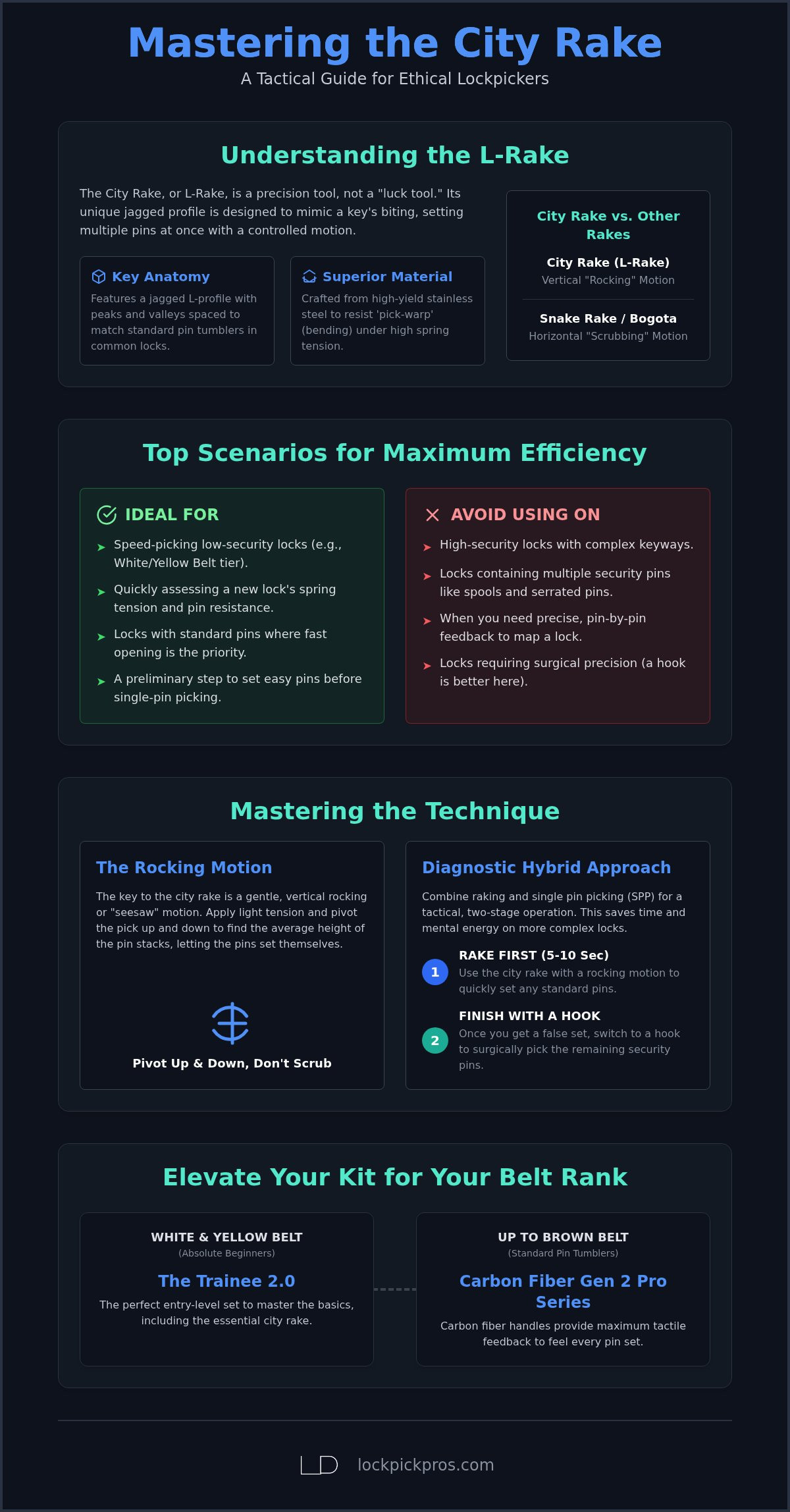
The city rake, frequently referred to as the L-rake, is a staple in any serious locksport kit. Its silhouette is unmistakable, featuring a series of jagged peaks and valleys that resemble a city skyline. Unlike many other rakes that rely on a chaotic scrubbing motion, the city rake is a precision instrument designed to mimic the specific biting of a real key. This allows you to manipulate multiple pins simultaneously by finding the "average" height of the pin stacks. Understanding when to use a city rake is the first step in moving from a beginner who "gets lucky" to a technician who understands the mechanical soul of the lock.
This tool is specifically engineered for a rocking motion rather than aggressive horizontal scrubbing.
The Anatomy of an L-Rake
When you look closely at the tip of a city rake, you'll notice the intentional geometry of its peaks and valleys. These aren't random. The spacing between these points is carefully calculated to align with the standard pin spacing found in most common household locks, such as those from Kwikset or Schlage. This layout allows the pick to interact with all five or six pins at once. To maintain the integrity of these fine points, we use high-yield stainless steel in our designs. This material is crucial because it resists pick-warp, which is the permanent deformation that occurs when a thin tool is subjected to high spring tension or improper force.
City Rake vs. Traditional Rakes
Many newcomers confuse the city rake with the snake rake or the Bogota. The difference lies in the direction of the work. While a snake rake excels at a horizontal scrubbing motion, the city rake requires a vertical rocking action. You apply light tension and pivot the pick up and down like a seesaw. This technique is especially effective on locks with radical biting, where the pin heights vary significantly from one to the next. A standard flat rake might get stuck or over-lift pins in these scenarios, but the L-profile of the city rake naturally finds the gaps. This versatility is why it's a core component of any beginner lock pick set. Knowing when to use a city rake allows you to clear standard pins quickly so you can focus your energy on the actual security pins that stand between you and an open.
When to Use a City Rake: Top Scenarios for Maximum Efficiency
Knowing when to use a city rake separates the button-mashers from the technicians. While a hook is surgical, the city rake is your scout. It is the most effective tool for White and Yellow belt locks that rely on standard pins. Before you run into security pins like spools or serrated drivers, the city rake can clear the path. It is also the perfect tool to quickly assess the spring tension of a new lock. If the pins feel stiff or the plug is sluggish, the rocking motion of the L-rake will tell you more in five seconds than a hook will in a minute.
Use the city rake in these specific situations:
- When facing a lock with unknown internals to test pin resistance.
- On locks with standard pins where speed is the priority.
- As a preliminary step to clear "junk" pins before single pin picking.
- When you need to verify if a lock is even functional before a deep pick session.
The Diagnostic Hybrid Approach
The diagnostic hybrid approach combines raking to set standard pins and single pin picking to finish security pins. Use the city rake for a 5-10 second burst to set 3 or 4 easy pins instantly. Once the plug moves, transition to a hook. This saves mental energy and prevents click-fatigue during long sessions, turning a struggle into a tactical two-stage operation. To keep your tools and other essentials organized for such operations, tak-ticalbags.com provides high-performance utility bags built for daily use.
Low-security padlocks like the Master Lock #3 are perfect targets. The city rake is the fastest way to earn a White Belt because these locks have loose tolerances and standard pins. Check our lock picking belt levels explained guide for more targets. Using a carbon fiber handle pick provides the feedback needed to feel each set.
Mastering the Technique: How to Rock and Scrub for Success
Once you understand when to use a city rake, you need to master the physical rhythm that makes it work. It's not about raw speed; it's about the angle and the arc of your movement. Start by choosing a high-quality tension wrench that fits snugly in the bottom of the keyway. Slide the city rake all the way to the back without forcing it. You want the peaks of the tool to rest gently against the pin stacks. Applying too much force during insertion can bend the pins or cause the pick to bind before you even start the rocking process.
The Rocking Motion vs. Scrubbing
Unlike the aggressive horizontal scrubbing used with a snake rake, the city rake thrives on a vertical rocking motion. Think of it like a see-saw. While applying light rotational force with your tension wrench, pivot the handle of the pick up and down. This moves the peaks of the tool against the pins at different heights, mimicking a key turning in the lock. If you scrub horizontally with an L-rake, you risk pick-warp or even snapping the tip of your tool. Instead, pulse your tension. This means briefly relaxing your finger on the wrench to let over-lifted pins drop back down without losing your progress on the pins that are already set. Listen for the distinct false clicks that tell you pins are dancing near the shear line. These tiny sounds are your roadmap to an open.
Managing Tension for Tactile Feedback
Feedback is everything in locksport. If you can't feel the pins hitting the shear line, you're just guessing. A carbon fiber handle is essential here because it transmits micro-vibrations from the metal pick directly into your fingertips. When you're rocking the tool, you need to toggle between heavy and feather tension. Heavy tension helps you find the binding pin, while feather tension allows the pins to actually move into place. Our Carbon Fiber Gen 2 - Pro Series was designed with this exact tactile requirement in mind. It gives you the clarity to know if a pin is set or if you've accidentally pushed it into a false set. Mastering this balance is what turns a trainee into a pro. Practice this for 10 to 15 minutes on a standard padlock to build the muscle memory required for higher belt ranks.
Limitations and Challenges: When the City Rake Isn’t the Answer
The city rake is a powerhouse for standard pins, but it has hard limits. Knowing when to use a city rake means recognizing the moment it stops helping and starts hurting your progress. If you're working on a lock and the plug isn't budging after 30 seconds of rocking, it's time to re-evaluate. High-security locks are designed specifically to defeat the "average height" strategy of a rake. Forcing a tool that isn't working won't get you the open; it will only damage your equipment.
Security Pins and False Sets
Security pins are the primary enemy of the city rake. A spool pin, for instance, has a narrowed center that catches on the shear line. When you rock the city rake, the spool pin often gets trapped in its "waist," leading to a deep false set. You'll feel the plug turn a few degrees, but the lock won't open. At this point, continued raking just grinds the pins and prevents them from setting properly. Serrated pins are even trickier. Their horizontal grooves produce multiple clicks, making it impossible for a rake to find the true shear line. When you hit these obstacles, you should transition to advanced lock techniques like single pin picking (SPP).
Keyway Obstructions and Pick-Warp
Tight, paracentric keyways present a physical barrier. If the keyway is shaped like a zig-zag, the wide profile of a city rake simply won't have the room to rock. Forcing the tool leads to pick-warp. This is a permanent deformation where the shaft of your pick curves or twists. If you see your tool looking like a banana, you've applied too much pressure in a space that was too small. For these narrow challenges, it's best to switch to the Pro Series Expansion kit. These thinner profiles allow you to navigate warding without damaging your gear.
Finally, remember the ethical code of our community. Never use your rakes on locks you don't own or locks that are currently in use. Picking a door lock you rely on can lead to a broken pin or a jammed mechanism, leaving you stranded. Keep your practice focused on your own hardware to stay within the legal and ethical boundaries of our sport. To ensure you have the right tool for the right job, consider upgrading to the Carbon Fiber Gen 2 Pro Series for better feedback and control.
Elevating Your Kit: Choosing the Right Tools for Your Belt Rank
Mastering the city rake is just one milestone in your locksport journey. As you progress through the belt ranking system, your tools need to evolve with your skills. While knowing when to use a city rake gives you a speed advantage on White Belt locks, higher tiers require more refined feedback. We've built a roadmap for your hobby through the Black Belt Challenge, ensuring you always have the right pick for the right lock.
If you're just starting out, we recommend The Trainee 2.0. It's an affordable entry point that includes the essential rake profiles needed to conquer standard pin-tumbler locks. As you move toward Orange and Green belts, you'll need the precision of the Carbon Fiber Gen 2 Pro Series. Priced at $149.00, this set is an investment in your technical progression. It provides the durability and sensitivity required to tackle security pins without the risk of pick-warp.
Why Carbon Fiber Handles Matter
We're proud to be the only manufacturer of real carbon fiber lockpicks. This isn't just about aesthetics. Carbon fiber is a rigid, lightweight material that transmits micro-vibrations far better than plastic or bare steel handles. When you're rocking an L-rake, these vibrations tell you exactly what's happening inside the keyway. This superior tactile feedback leads to faster learning and helps you attain higher belt ranks more quickly. You'll feel the difference on the very first click.
Joining the Black Belt Challenge
Ready to take your skills to the next level? Join over 10,000 ethical lockpickers in our Black Belt Challenge. This community-driven program turns your practice into a game. We've even set a $5,000 bounty for the community once we hit our collective social reach goal. It's a great way to stay motivated while earning your way up the ranks.
Our share-to-earn loop is simple. Post your progress on social media using our tools, tag us, and earn reward picks as you level up. It's our way of rewarding your dedication to the sport. Whether you're still figuring out when to use a city rake or you're deep-picking high-security dimple locks, there's a place for you in our community. Grab your kit, start picking, and let's see you earn that next belt.
Master the City Rake and Level Up Your Skills
You've now seen how the city rake serves as more than just a quick open tool; it's a vital scout for your locksport kit. By mastering the rocking motion, you can quickly clear standard pins and identify where security pins are hiding. Knowing when to use a city rake allows you to save time and mental energy, especially when you're working through those foundational White and Yellow belt locks. It's the perfect bridge between basic raking and technical single pin picking.
Ready to feel every micro vibration as you rock those pins? It's time to upgrade your feedback with the Carbon Fiber Gen 2 Pro Series. You'll join a growing community of over 10,000 ethical hobbyists who trust our precision gear for their journey. Every set includes a lifetime warranty and ships within 24 hours from the USA. Don't let dull feedback hold back your progression. Get the tools that help you hear the secrets of the keyway. Keep practicing, stay ethical, and we'll see you at the next belt rank.
Frequently Asked Questions
Is raking a lock considered a "real" lockpicking skill?
Yes, raking is a foundational skill in the locksport community. While single pin picking is required for higher belt ranks, the community views raking as a valid way to learn tension control and quickly open lower-security locks. It's often the first technique beginners learn because it provides immediate results and builds confidence before moving to more surgical picking methods. Every ethical lockpicker should master both raking and single pin picking.
What is the difference between a city rake and a Bogota rake?
The primary difference is the profile and the intended motion. A city rake has a jagged L-shape that mimics key biting and works best with a vertical rocking motion. A Bogota rake features a triple peak design intended for a horizontal scrubbing or dragging motion. While both are rakes, the city rake is more specialized for locks with radical biting where standard scrubbing might fail to set the pins.
Can a city rake damage my practice lock?
It can if you use excessive force or improper technique. Aggressive raking can cause internal wear on the pins or even deform the springs. This is why we emphasize using light tension and a controlled rocking motion. If you're practicing on a metal cutaway lock, you can actually see the pins reacting. This visual feedback helps you avoid the heavy-handedness that leads to permanent mechanical damage or jammed mechanisms.
How much tension should I use when rocking a city rake?
You should start with very light, feather tension. The goal of the rocking motion is to allow the pins to bounce and find the shear line. If your tension is too heavy, the pins will bind and won't move. Knowing when to use a city rake also means knowing when to pulse your tension wrench. Briefly letting off pressure allows over-lifted pins to drop back into place without losing your progress.
Why does my city rake keep getting stuck in the keyway?
This usually happens because of tight warding or a paracentric keyway. If the keyway has a zig-zag shape, the wide profile of the city rake doesn't have enough room to rock vertically. It can also happen if you're pushing the pick too deep into the back of the lock. Try using a thinner pick profile or shifting to a hook if the keyway is too restrictive for the tool's jagged peaks.
Do I need a city rake to get my White Belt?
No, you don't specifically need a city rake, but it's one of the fastest ways to achieve it. The White Belt requirement involves opening any lock with any tool. Since many White Belt locks have standard pins and loose tolerances, a city rake is often the most efficient choice for a quick open. It's a great confidence builder for anyone just starting their journey in the locksport community.
Can I use a city rake on locks with spool pins?
You can, but it's rarely successful. Spool pins are security pins designed to trap your pick in a false set. While a city rake might set a few standard pins, the spools will almost always require single pin picking to finish the open. This is a prime example of when to use a city rake as a diagnostic tool to set the easy pins before switching to a hook.
What should I do if my city rake starts to bend?
Stop immediately to prevent pick-warp. Bending is a sign that you're using too much force or the keyway is too narrow for the tool. If the bend is slight, you can sometimes gently straighten it, but the metal will be weakened. It's better to switch to a high-yield stainless steel pick or a thinner profile from our Pro Series Expansion to handle those tougher, more restrictive keyways safely.