

Locksport for Beginners: 2026 Guide to Ethical Picking
What if the lock on your desk isn't just a security device, but the world's most rewarding mechanical puzzle? For many, diving into locksport for beginners feels like stepping into a secret society where you're always one satisfying click away from a new obsession. It's natural to feel a bit of hesitation. You might worry about accidentally breaking a lock or feel totally lost when people start talking about shear lines and spool pins. We've all stood there, staring at a pile of metal tools and wondering which ones actually belong in a high quality starter set.
You aren't alone in that confusion, and we're here to guide you through this hobby with a focus on ethics and community. This guide will help you successfully pick your very first practice lock while staying on the right side of the law. We'll explore the official 2026 LPU belt ranking system and show you exactly how to progress from a White Belt trainee to a Black Belt master. You're about to stop guessing and start picking with the precision of a true locksport enthusiast.
Key Takeaways
- Master the LPU belt ranking system to turn your learning journey into a structured path toward expert-level skill refinement.
- Discover why quality beats quantity when selecting your first kit and why professional-grade materials are essential for your foundational training.
- Learn the core mechanics of locksport for beginners, including the "light-as-a-feather" tension technique needed to identify your first binding pin.
- Understand the ethical code of the community to ensure your new hobby remains a legal and respected sport.
- Kickstart your progression with the Black Belt Challenge and learn how to record your first "Pick and Gut" video for community verification.
Welcome to Locksport: The Martial Arts of Puzzles
Welcome to the world of Locksport. This competitive and recreational study of lock mechanics is the foundation of locksport for beginners. Think of it as the martial arts of puzzles. Just like a traditional dojo, we focus on discipline, patience, and skill progression. You don't just "break in" to things. Instead, you earn your way through a structured ranking system. This is a journey of mastery where every click of a pin represents a victory of logic over metal hardware.
It's vital to draw a clear line between what we do and other professional fields. We aren't locksmiths providing a commercial service, and we certainly aren't criminals. We're hobbyists. For us, a lock is a mechanical riddle waiting to be solved. Engaging in locksport for beginners offers incredible mental benefits. It sharpens your focus. It builds extreme patience. It turns complex problem-solving into a tactile experience you can actually feel in your hands. You'll find that the community is built on mutual respect and a shared passion for precision engineering.
The Ethical Code of the Hobbyist
Being an ethical lockpicker means following two non-negotiable rules. First, never pick a lock you don't own or haven't received explicit permission to pick. Second, never pick a lock that is currently in use. This "lock in use" rule is critical for your own protection. If you break a practice lock, you're only out a few dollars. If you break the lock on your front door, you're locked out of your own house. These rules protect our community's reputation and your legal standing. In states like California, updated 2026 statutes under Penal Code 466 look at your behavior and intent. Following these rules proves you're a sportsman and a responsible hobbyist.
Is Lockpicking a Useful Skill in 2026?
The world is moving toward digital security, but the global mechanical lock market is still projected to hit $13.43 billion this year. Understanding these physical devices is more relevant than ever. Once you learn how to defeat a lock, you finally understand how to buy a better one for your own home. You'll start seeing security vulnerabilities that most people ignore. It changes your perspective on personal safety. If you're wondering is lockpicking a useful skill? the answer lies in the awareness you gain. You'll stop trusting cheap hardware and start investing in real security. This hobby makes you a more informed consumer in a world that often relies on the illusion of safety.
The Roadmap to Mastery: Understanding Belt Ranks
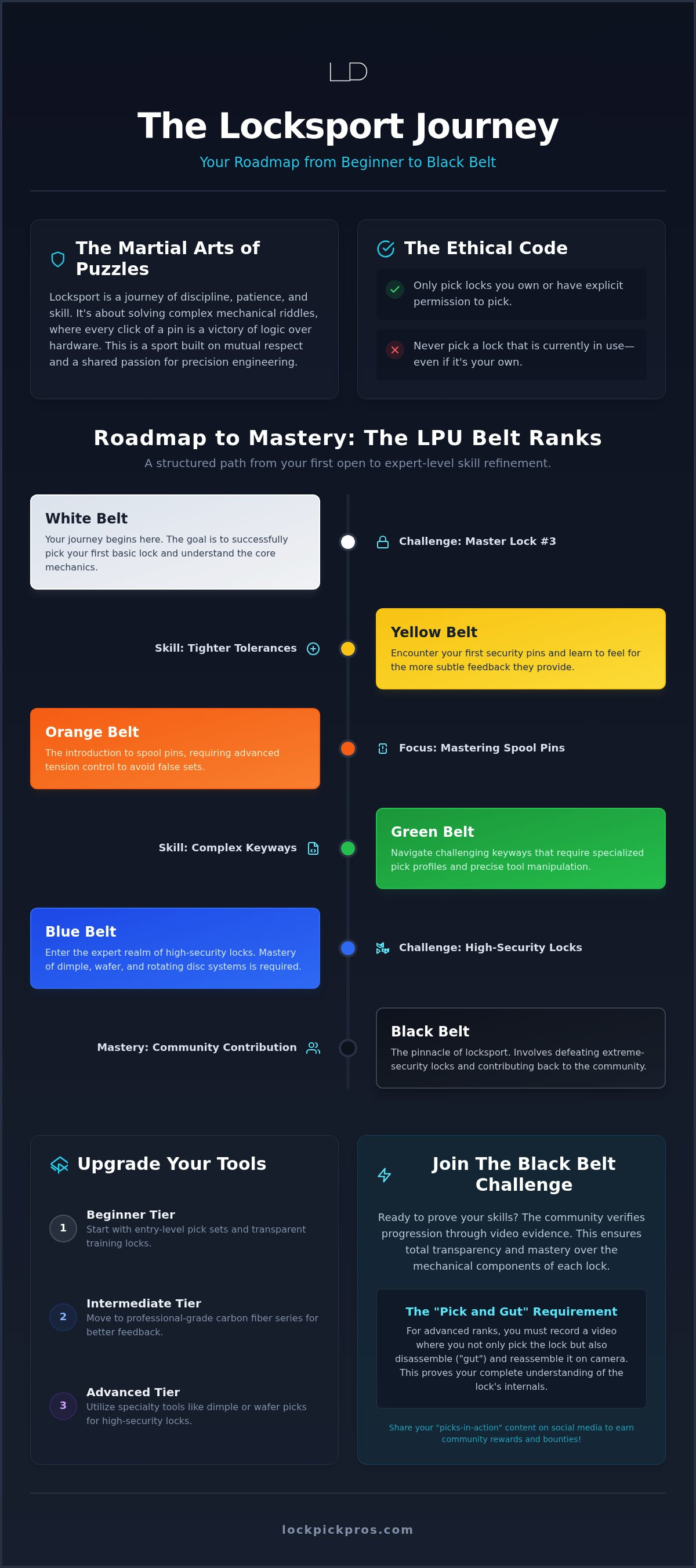
Think of locksport as a structured journey rather than a random collection of skills. The LockPickers United (LPU) belt system is the industry standard that turns locksport for beginners into a legitimate competitive pursuit. This ranking framework provides a clear path for skill refinement. It moves you from a curious trainee to an expert-level picker through a series of increasingly difficult challenges. Progression isn't just about what you can open. It also involves contributing to the community through mentorship and technical documentation. You're not just learning a trick; you're joining a sport with a deep history of discipline.
White to Green: The Foundational Tiers
Your journey starts at the White Belt. To earn this, you typically need to pick a basic padlock like the Master Lock #3 and submit a video for verification. It sounds simple, but that first successful open is a massive milestone. For technical diagrams on how these pins align during your first attempts, you should consult Practical Training: Earning Your White Belt. As you move to Yellow Belt, you'll encounter tighter tolerances and basic security pins that require more precise feedback. By the time you reach Orange or Green, you'll be mastering spool pins and navigating more complex keyways. For a deep dive into every 2026 requirement, check out our guide on Lock Picking Belt Levels Explained.
Blue to Black: Entering the Expert Realm
The jump to Blue Belt marks your transition into high-security locks like dimple, wafer, and rotating disc systems. As of the January 2026 community update, picking a Magnum Mont Blanc is a standard requirement for this tier. At this level, you can't just pick the lock. You must also "gut" it. This process involves taking the lock apart and reassembling it on camera to prove you haven't modified the internals. This ensures total transparency and mastery over the mechanical components. As you advance toward these intermediate and advanced ranks, you'll want tools that provide maximum tactile feedback, such as the Carbon Fiber Gen 2 Pro Series.
Reaching Black Belt status is the ultimate achievement in locksport for beginners who have stayed the course. The June 2026 standards are higher than ever. You must pick and gut two locks from an elite list that now includes the MIWA WR and the EVVA MCS. You also need to mentor at least two other pickers and complete high-level technical projects. It's a prestigious rank that signifies you've reached the pinnacle of the global community. Every step of this roadmap is designed to build your confidence and sharpen your problem-solving abilities.
Selecting Your First Kit: Essential Tools for Trainees
When you start your journey in locksport for beginners, you might feel tempted to buy the largest kit you can find. Don't fall for the 50-piece trap. Most of those tools are fillers you'll never use. The philosophy of "Less is More" is vital here. A smaller, high quality set allows you to focus on the feel of the pins without getting distracted by unnecessary clutter. You need tools that translate the tiny vibrations from the lock to your fingertips. This is where material quality matters. While many cheap sets use mystery alloys, professional tools use 301 Stainless Steel or high durability Carbon Fiber. These materials offer the rigidity needed to feel the "click" of a setting pin without the pick bending or snapping.
Every successful trainee needs the "Big Three" tools: a hook, a rake, and a tension wrench. These are the workhorses of the sport. If you want a kit designed specifically for the White Belt requirements we discussed earlier, The Trainee 2.0 is the definitive starter set. It provides exactly what you need to open your first practice locks without the confusing fluff. Starting with the right gear ensures you don't develop bad habits caused by flexible, low quality steel.
Hook Picks vs. Rakes: Choosing Your Approach
There are two primary ways to approach a lock. Single Pin Picking, or SPP, is considered the "true" way to learn mechanics. You use a hook pick to manipulate one pin at a time. This method is required for higher belt ranks because it proves you understand exactly what's happening inside the cylinder. Raking is a "low-skill, high-speed" method. You scrub a rake across the pins to set them through sheer probability. It's great for simple padlocks, but every locksport athlete must master the Short Hook first. The Short Hook is the most versatile tool in your case. It provides the precision needed to navigate tight keyways and lift individual pins to the shear line.
The Secret is in the Tension
Tension is 90% of the skill in lockpicking. Without it, the pins just fall back down. You'll use two main styles: Top of Keyway (TOK) and Bottom of Keyway (BOK) tensioning. BOK is common for beginners because it's easy to keep the wrench in place. However, TOK tensioning is often better because it leaves more room for your pick to move. Your tension wrench is your communication line. It provides the "feedback" necessary to feel which pin is binding. Apply "light-as-a-feather" pressure. If you press too hard, the pins will jam. If you're too light, they won't stay set. Mastering this delicate balance is what separates a trainee from a pro.
Practical Training: Earning Your White Belt
You've got your tools. You've got your lock. Now it's time to experience that first satisfying click. Practical training is where locksport for beginners transforms from theory into a tactile skill. Success isn't about strength. It's about finesse and listening to what the metal is telling you. Follow these four steps to secure your first open and start your journey toward community verification.
- Step 1: The Tension. Insert your tension wrench into the keyway. Apply "light-as-a-feather" pressure. If your finger is turning white, you're pushing too hard. You only need enough force to nudge the internal plug once the pins align.
- Step 2: The Search. Slide your hook pick into the lock. Gently probe each pin from front to back. You're looking for the "binding pin." This is the specific pin that resists your pick while the others feel springy.
- Step 3: The Set. Once you find the binder, apply steady upward pressure. Lift it until you hear or feel a distinct "click." This indicates the pin has reached the shear line and is trapped between the plug and the housing.
- Step 4: The Open. Repeat the search for the next binding pin. As each pin sets, you'll feel the plug move slightly. When the final pin clicks into place, the plug will rotate freely. The lock pops open. Congratulations. You've just picked your first lock.
Anatomy of a White Belt Target: Master Lock #3
The Master Lock #3 is the universal first target for a reason. It features a simple 4-pin stack and wide keyway tolerances that are very forgiving for new pickers. You won't find complex security pins like spools or serrations here. It provides excellent tactile feedback, making it the perfect "final exam" for the White Belt rank. If you're still wondering if your gear is up to the task, read our guide on What is in a Beginner Lock Pick Set? to ensure you haven't missed a crucial tool.
Using Practice Locks to "See" the Mechanism
Clear acrylic locks are common in many starter kits. They're great for visualization because you can see the pins move. However, they're bad for developing tactile feedback. The plastic doesn't vibrate like metal does. Cutaway locks are the professional choice for skill refinement. These are real metal locks with a portion of the side removed. They allow you to see the pins while still feeling the true mechanical resistance of the springs. You should move to "blind" metal locks as soon as possible. Real mastery comes from "seeing" with your fingers rather than your eyes. Once you've mastered the feedback of a standard padlock, you'll want tools that offer even more precision. Upgrade to the Carbon Fiber Gen 2 Pro Series to feel the subtle nuances of high-security pins.
The Black Belt Challenge and Community Rewards
The journey doesn't end when you pop your first Master Lock. In fact, it's just beginning. We want to see you climb the ranks, which is why we created the Lockpick Pros Black Belt Challenge. This free program is designed to turn your interest in locksport for beginners into a lifelong pursuit of mastery. You progress one belt at a time, documenting your wins and sharing them with the community. To verify your rank for higher tiers, you'll need to record "Pick and Gut" videos. These videos prove you can successfully defeat a lock and then disassemble it to show the internal pins are stock. It's the ultimate proof of skill and transparency.
We also believe in a "Share-to-Earn" philosophy. When you post your "picks-in-action" content on social media, you aren't just showing off. You're helping grow the sport. By tagging your progress and sharing your successes, you can earn exclusive discounts on your next gear upgrade. For 2026, we've even introduced a Community Bounty. If our collective community reach hits specific milestones on social platforms, we release special rewards and gear bonuses for everyone involved. It's about building a movement of ethical pickers who support each other's growth.
Earning Your Way to Professional Tools
As you move beyond the White and Yellow belts, your basic tools will eventually meet their match. High security locks require higher durability and better tactile response. This is the perfect time to upgrade to the Carbon Fiber Gen 2 Pro Series. These tools provide the extreme feedback needed for intermediate tiers where spool and serrated pins are common. Once you reach the advanced ranks, you'll need to master non-standard keyways. This requires specialty gear like Dimple Picks to navigate complex civil locks. Always master your foundational tools first, but don't be afraid to level up your kit as your skills refine.
Finding Your Local Locksport Tribe
You don't have to learn in a vacuum. The digital world is full of mentors ready to help you troubleshoot a stubborn binding pin. Join the Discord and Reddit communities where thousands of hobbyists share tips every day. If you prefer in-person interaction, look for TOOOL (The Open Organization Of Lockpickers) meetings in your area. These chapters are the heart of the hobby. They offer a safe space to practice and learn from those who have already earned their higher belts. The ethical lockpicker community is your best resource for 2026 and beyond. Stay curious, stay legal, and keep picking.
Master the Art of the Open
You've seen how the world of locksport combines complex mechanical puzzles with a structured path to mastery. By understanding the 2026 belt requirements and following our strict ethical code, you aren't just picking locks. You're joining a passionate global community of problem solvers. Success in locksport for beginners depends on your patience and the quality of your feedback. You now have the roadmap to move from your first Master Lock #3 to the prestigious ranks of the Black Belt Challenge.
We're committed to your growth as an ethical hobbyist. You can earn rewards through our unique Share-to-Earn program by documenting your progress on social media. Our brand maintains a 100% ethical hobbyist focus to ensure the sport remains respected and legal. To make your entry even easier, we provide free shipping on all beginner bundles. The tools you choose today will define your tactile experience and skill refinement for years to come.
Ready to feel that first satisfying click? Start Your Journey with The Trainee 2.0 Starter Kit and earn your first belt. The community is waiting to welcome you to the ranks. Keep practicing, stay curious, and enjoy the thrill of the open.
Frequently Asked Questions
Is lockpicking legal for hobbyists in 2026?
Lockpicking is legal for hobbyists in the majority of U.S. states as of August 2026. Statutes in states like California, Texas, and New York focus on your intent rather than mere possession of tools. If you follow the ethical code of the hobby and only pick locks you own, you're on safe legal ground. Always check your specific local regulations to stay informed about 2026 updates.
What is the best beginner lock pick set to start with?
The Trainee 2.0 is the definitive choice for anyone starting locksport for beginners. It focuses on the essential "Big Three" tools rather than overwhelming you with a 50-piece kit of low-quality mystery metal. You get high-durability steel picks and a tension wrench that provide the precise feedback needed to feel every pin click into place during your foundational training.
How long does it take to earn a White Belt in locksport?
Most beginners earn their White Belt in just a few hours of dedicated practice. The requirement involves picking a simple padlock, such as the Master Lock #3, and submitting a video for verification. Once you understand how to find the binding pin and apply light tension, that first open happens quickly. It's a fast and rewarding entry point that builds your confidence immediately.
Can I pick the locks on my own house for practice?
No, you should never pick a lock that is currently in use, even if you own the home. This is a core rule of the ethical picking community. Picking a lock can cause internal damage or break a pick inside the keyway. If that happens to your front door, you'll be facing an expensive emergency locksmith bill and a very long night locked outside.
What is the difference between single pin picking and raking?
Single pin picking (SPP) involves manipulating one pin at a time for total mechanical precision. It's the primary way to master locksport for beginners and is required for all higher belt ranks. Raking is a faster, less precise method where you scrub the pins to set them by chance. While raking is a useful skill, SPP is what builds true technical mastery.
Do I need a clear practice lock to learn?
You don't strictly need a clear practice lock, though they're helpful for visualizing internal mechanics. Many hobbyists prefer cutaway locks because they use real metal components. Metal provides the authentic tactile feedback and vibrations that plastic locks lack. Moving to "blind" metal locks as soon as possible is the best way to sharpen your senses and improve your skill refinement.
What is the LPU belt ranking system?
The LPU ranking system is a nine-tier framework that tracks your progress from White to Black belt. It's maintained by the LockPickers United community and serves as the global standard for the sport. Each level requires you to pick increasingly difficult locks. For higher ranks, you must also contribute to the community through mentorship or technical projects to prove your expertise.
How do I join the Black Belt Challenge?
You can join the Black Belt Challenge by signing up on our community page and starting your journey at the White Belt level. Record your "Pick and Gut" videos as you advance to prove your skills to the moderators. Don't forget to participate in our Share-to-Earn program by posting your progress on social media to earn rewards, community bounties, and gear discounts.